
At AWS re:Invent 2025, AWS unveiled a bold vision: shifting from static chatbots to autonomous, long-running AI agents — systems capable of coding, security auditing, DevOps, and ongoing workflows for hours or even days without human oversight. This move — combining new models, custom AI infrastructure, and agent frameworks — may well signal a new era in enterprise AI.
Below, we explore what AWS announced, what frontier AI agents are, why they matter, real-world implications, and what challenges still need to be addressed.
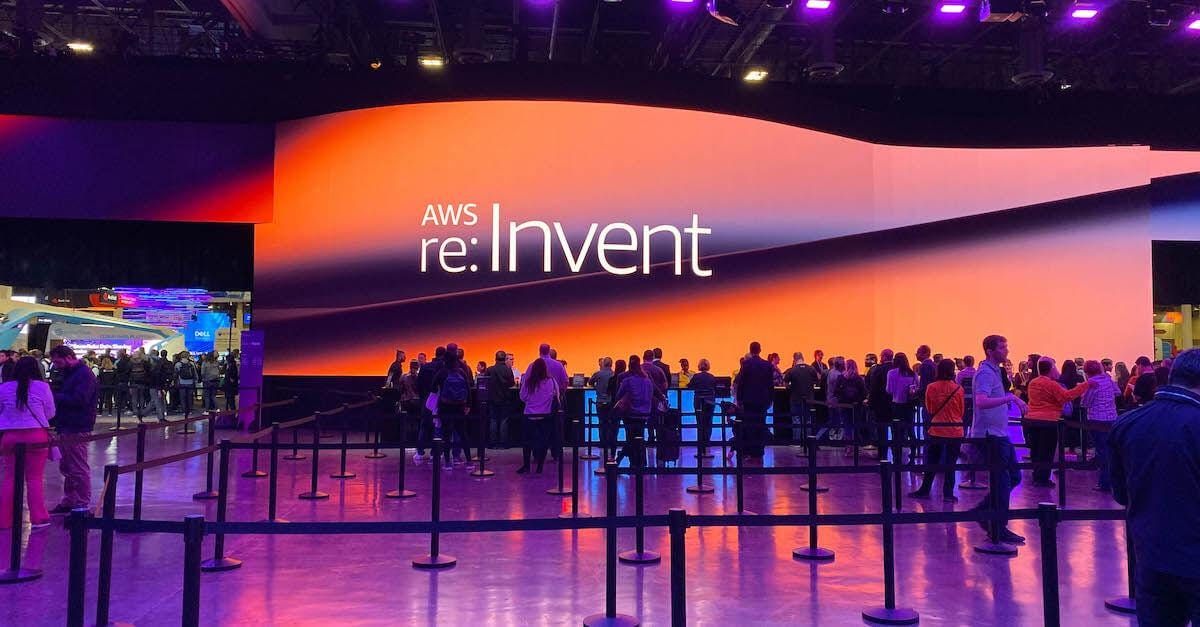

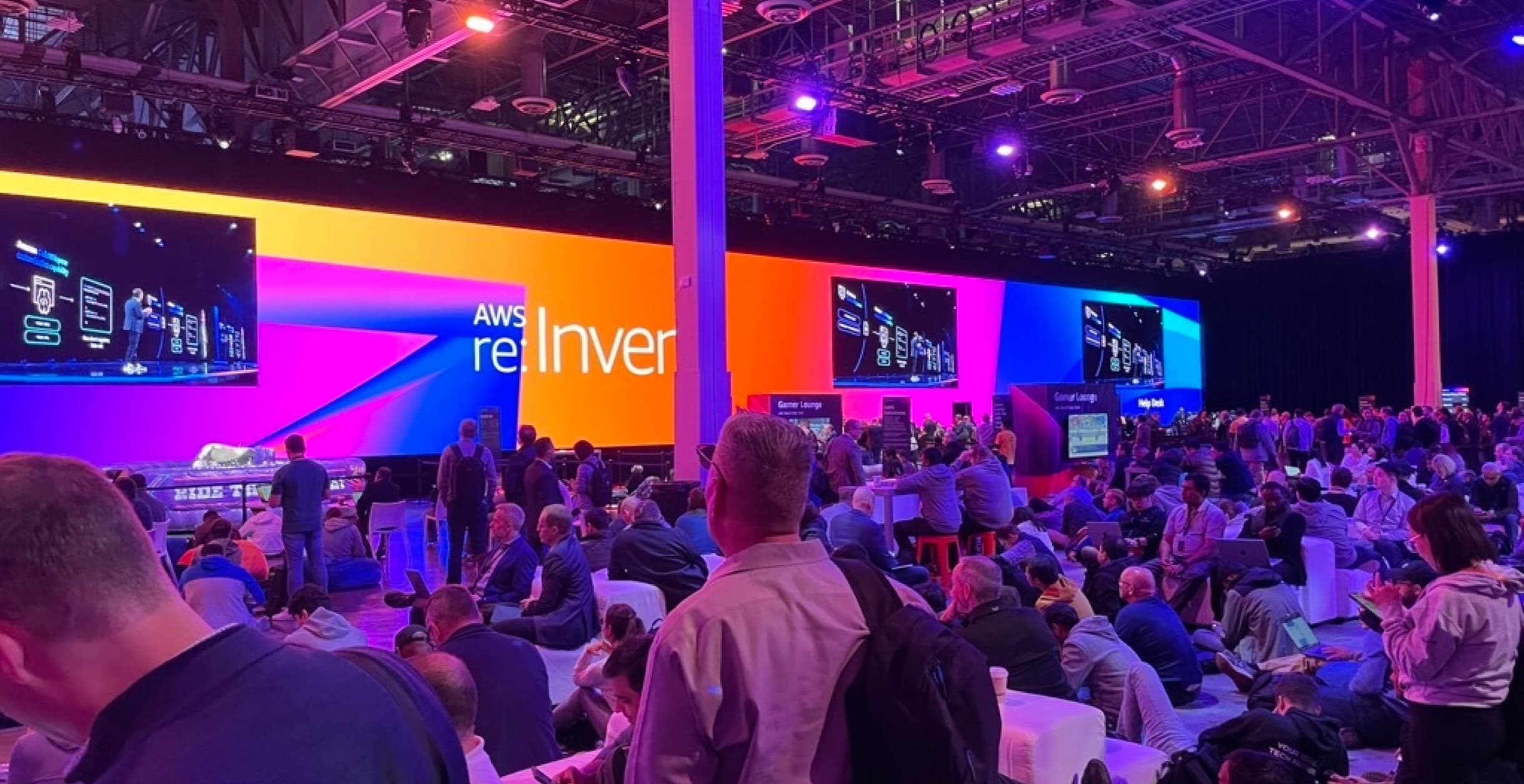
Image Source: AWS Event
What Did AWS Announce at re:Invent 2025?
At the conference, AWS rolled out multiple innovations under a broad AI push. Key announcements include:
- Frontier AI Agents: A set of autonomous agents — including Kiro (a virtual developer), an AWS Security Agent, and an AWS DevOps Agent. These agents are designed to run tasks independently for extended periods (hours/days).
- New “Nova 2” Model Family: Expanded foundation models for reasoning, multimodal processing, code generation — including a new model called Nova 2 Omni capable of handling text, images, video, and speech.
- AI Infrastructure Upgrades – Trainium3 UltraServers & Graviton5 CPUs: High-performance, energy-efficient hardware aimed at reducing cost and latency for AI workloads.
- Expanded Agent Platform: AgentCore & Agent Policies: AWS has enhanced its agent deployment framework (Amazon Bedrock AgentCore) with policy controls, memory capabilities (episodic experiences), and evaluation tools to monitor agent behavior and safety.
- Custom AI Model Service – Nova Forge: Enterprises can now build domain-specific “Novella” models by fine-tuning Nova models on their own data, facilitating customization without building from scratch.
- AI Factories for On-Prem / Private-Cloud Deployment: For enterprises concerned with privacy, data residency, or compliance, AWS introduced AI Factories — dedicated AI infrastructure (chips, networking, storage) deployable in in-house data centers.
Together, these components represent a holistic push: not just models, but infrastructure, frameworks, and governance — enabling AI agents as first-class production tools, not toys or experiments.
What Are “Frontier AI Agents”? How Do They Differ from Chatbots?
Traditional chatbots — whether rule-based or LLM-powered — are generally reactive: they wait for user input, respond, and stop. They don’t maintain long tasks, cross-session context, or perform complex tool-based workflows.
Frontier AI agents, by contrast, are autonomous, goal-driven, and persistent. Key characteristics:
- Long-lived execution: Capable of working for hours or days on tasks such as coding features, running tests, security audits, or DevOps workflows.
- Tool use & orchestration: They can call APIs, execute commands, manage code repositories, deploy infrastructure — not just generate text.
- Memory / state across sessions: Through AgentCore Memory functionality, agents can remember past interactions and context, enabling multi-stage workflows spanning days.
- Safety, monitoring & policy controls: Unlike naive LLM-bots, AgentCore includes evaluators for correctness and safety, and allows human-defined boundaries on what agents can/cannot do.
- Integration with enterprise infrastructure: Designed to work with code, cloud infra, deployment pipelines — not just chat interfaces.
In short: frontier agents are not chatbots — they are autonomous digital workers, capable of coordinating complex tasks end-to-end without constant human prompts.
Key Use Cases and Real-World Applications
1. Autonomous Software Development (via Kiro)
- The Kiro agent can write code, implement features, refactor, test, and even follow team conventions — potentially accelerating development cycles.
- For businesses, this could reduce developer workload, accelerate time-to-market, and allow engineers to focus on higher-level design or oversight rather than boilerplate coding or repetitive tasks.
2. Security and Compliance Auditing
- The AWS Security Agent can continuously monitor codebases, dependencies, infrastructure configurations — detecting vulnerabilities, misconfigurations, or compliance violations without human intervention.
- This continuous, automated security approach could help organizations improve security posture, reduce manual audit burden, and respond faster to threats.
3. DevOps & Infrastructure Management
- The DevOps Agent can manage deployments, monitor system health, automate rollbacks, run CI/CD pipelines, and handle cloud operations.
- For large-scale or complex infrastructure, such agentic automation could reduce operational overhead and increase reliability.
4. Legacy Code Modernization & Cross-Platform Porting
- As part of AWS’s broader offering, the new agentic capabilities feed into tools like AWS Transform, which now supports automated modernization of legacy applications — even custom frameworks or old .NET/VMware systems.
- Enterprises with technical debt can leverage agents to migrate, refactor, or modernize legacy systems more quickly and with less manual effort.
5. Custom AI Models & Applications via Nova Forge
- Organizations can build their own domain-specific AI models — for highly specialized tasks (e.g., medical, finance, legal, internal workflows) — by fine-tuning Nova base models on proprietary data.
- Combined with frontier agents, this enables specialized, secure, enterprise-ready automation for niche verticals.
6. On-Prem / Compliance-Sensitive Deployments through AI Factories
- For industries facing regulatory or data sovereignty concerns (government, healthcare, finance), AWS AI Factories enable deployment of high-performance AI infrastructure within private data centers.
- This allows full agentic capabilities without exposing sensitive data to shared cloud environments — a big win for compliance-heavy sectors.
Why This Shift Is Significant: From Chatbots to Autonomous Agents
A. Productivity and Cost Efficiency
By automating large portions of development, security, and DevOps workflows, organizations can significantly reduce manual labor, speed up development cycles, and lower operational costs — potentially transforming how software is built and maintained.
B. Enterprise-Ready AI Infrastructure
AWS is not just offering models — they offer hardware, infrastructure, orchestration, monitoring, compliance controls — making agentic AI viable for large enterprises, not just research labs.
C. Democratization of AI-Powered Workflows
With Nova Forge and agent frameworks, companies and teams of all sizes (not just Big Tech) can now build specialized AI agents tailored to their needs, leveling the playing field.
D. New Paradigm: Agents Instead of Assistants
Traditional AI assistants respond to prompts. Frontier agents act — they plan, execute, monitor, iterate, and persist — fundamentally reshaping expectations of what AI tools can do.
Challenges, Risks & What’s Still Uncertain
Despite the promise, several challenges and uncertainties remain:
- Reliability & correctness: Autonomous agents working over long periods — especially in coding, infrastructure, or security — must be extremely reliable. Bugs or misconfigurations introduced by an agent could have serious consequences.
- Safety and governance: While AgentCore includes policy controls and evaluation, ensuring agents behave within safe and compliant boundaries — especially when acting autonomously — remains a major concern. Misuse, unintended side effects, or security vulnerabilities are possible.
- Transparency & auditability: For regulated industries, decisions made by agents may need to be auditable. Ensuring traceability of actions, rationale, and approvals in an agentic workflow could be challenging.
- Resource costs and compute requirements: Despite infrastructure improvements (Trainium3, Graviton5), extensive agent workflows (especially for big codebases or multimodal tasks) may still demand significant compute resources.
- Human oversight & trust: Organizations may be reluctant to relinquish control fully to agents — change management, governance frameworks, and trust-building will be essential.
- Skill gap and adoption barriers: Teams must learn to integrate, monitor, and manage agentic workflows instead of traditional CI/CD or DevOps workflows, requiring new processes and expertise.
What This Means for Different Stakeholders
Developers & Dev Teams
- Frontier agents like Kiro may help you automate repetitive coding tasks, implement boilerplate, or generate prototypes — freeing up time for creative work.
- But organizations should adopt a “human-in-the-loop” approach: use agents for automation and augmentation, not full autonomy — at least until trust in their reliability grows.
Enterprises & CTOs
- AWS’s integrated stack (models + infrastructure + agent frameworks) offers a potentially cost-effective path to large-scale automation, code modernization, and infrastructure management.
- However, you must invest in governance, monitoring, testing pipelines, and audit mechanisms to ensure agent actions remain safe and compliant.
AI Researchers & Vendors
- The frontier-agent paradigm could open new research directions: long-term agent memory, robotics-like autonomy in software space, multimodal agents combining code, docs, deployment, infra.
- Vendors building AI tooling or enterprise software should consider how to integrate or compete with agentic automation.
Regulators & Compliance Teams
- As agents take more autonomous actions, transparency, audit logs, and compliance controls will become more important. Regulatory frameworks may need to evolve to consider AI-agent–driven automation as opposed to human-driven actions.
The Bigger Picture: What This Means for the Future of Work and AI
AWS’s 2025 announcements signal a shift not just in technology — but in how we think about AI in real-world operations. The rise of frontier AI agents could redefine:
- Software development paradigms — from manual coding and constant human oversight to agent-driven feature development, refactoring, and maintenance.
- Enterprise operations & cloud governance — with agents managing infrastructure, compliance, security, and deployments — reducing human burden and accelerating cycles.
- Democratization of AI automation tools — with platforms like Nova Forge making model customization accessible, and AI Factories enabling private-cloud deployment — broadening adoption beyond big tech.
- Rise of “Digital Workforce” — AI agents functioning as employees: coding, maintaining, securing, and deploying systems around the clock.
- New challenges for governance, oversight, and ethics — as more control is delegated to autonomous systems, frameworks for auditing, accountability, and safe deployment will become essential.
Conclusion
The 2025 wave of AWS AI announcements — frontier agents, Nova 2 models, custom-training platforms, upgraded infrastructure — represents a major inflection point. It grants organizations more power than ever before: they are able to construct, execute, and operate AI-based automation on a large scale. It gives the developers an escape of repetitive works and a faster path to innovation. And in the case of the AI ecosystem it is an indication that we are entering a new stage of chatbots becoming autonomous persistent agents – digital workers capable of planning and acting as well as learning and continuing.
That said, with great power comes great responsibility: reliability, security, governance, oversight — these will make or break the promise of agentic AI. As enterprises begin to adopt these systems, careful testing, robust policies, and human-in-the-loop governance will be critical.
Ultimately, if AWS’s vision delivers, we might soon live in an era where much of our digital work is handed off — not to human remote employees — but to intelligent, autonomous AI agents.
FAQs
What are “frontier AI agents” from AWS?
Frontier AI agents are autonomous, long-running AI systems announced by AWS at re:Invent 2025. They can perform complex workflows — coding, DevOps, security audits — over hours or days without human intervention. Examples include Kiro (virtual developer), AWS Security Agent, and AWS DevOps Agent.
How are these different from chatbots?
Unlike chatbots that respond to prompts, agents act: they internally plan tasks, execute operations (code, API calls, infra changes), maintain state and memory across sessions, and integrate with tools and cloud infrastructure. They are goal-driven autonomous workers, not reactive conversation tools.
What new AI models did AWS unveil?
AWS expanded its Nova model family, introducing Nova 2 — including Nova 2 Omni, a multimodal model (text, speech, image, video) — to power agent reasoning, multimodal tasks, code generation, and more.
Can companies build their own custom AI models on AWS now?
Yes. Through Nova Forge, customers can fine-tune existing Nova base models using their own proprietary data — enabling tailored AI models (so-called “Novella” models) for domain-specific workflows.
What infrastructure does AWS provide to support these agents?
AWS introduced new high-performance infrastructure: Trainium3 UltraServers for AI workloads, Graviton5 CPUs for general workloads, and a push to deploy AI Factories (dedicated AI infrastructure in customer data centers) — enabling scalable training and inference at lower cost and latency.
Are these agents available now?
Preview versions of the frontier agents, Nova 2 models, and updated AgentCore features are already announced — availability may vary by region and depends on AWS rollout schedule.
What are the main risks with adopting frontier agents?
Risks include reliability (bugs or incorrect actions), security (agent permissions & unintended changes), compliance (auditability of agent actions), resource costs, and organizational readiness for autonomous agent workflows.