
The Defense innovation process has entered an unpredictable phase because a German startup has created bio-robotic “cyborg” cockroaches that contain electronic components and artificial intelligence for use in military scouting operations. The system employs live biological organisms together with cutting-edge sensing technologies and communication systems and control mechanisms to collect intelligence data in locations where traditional machines lack access. The development enables strategic operations between surveillance and disaster response and military reconnaissance while raising multiple ethical and legal challenges.
The new field demonstrates how robotics and artificial intelligence and biological sciences combine to develop unique intelligence systems that start from basic conceptual tests and advance to NATO field tests. The article provides an analysis of system operations, including technical details, current functions, example applications, operational difficulties, and projections for upcoming developments.
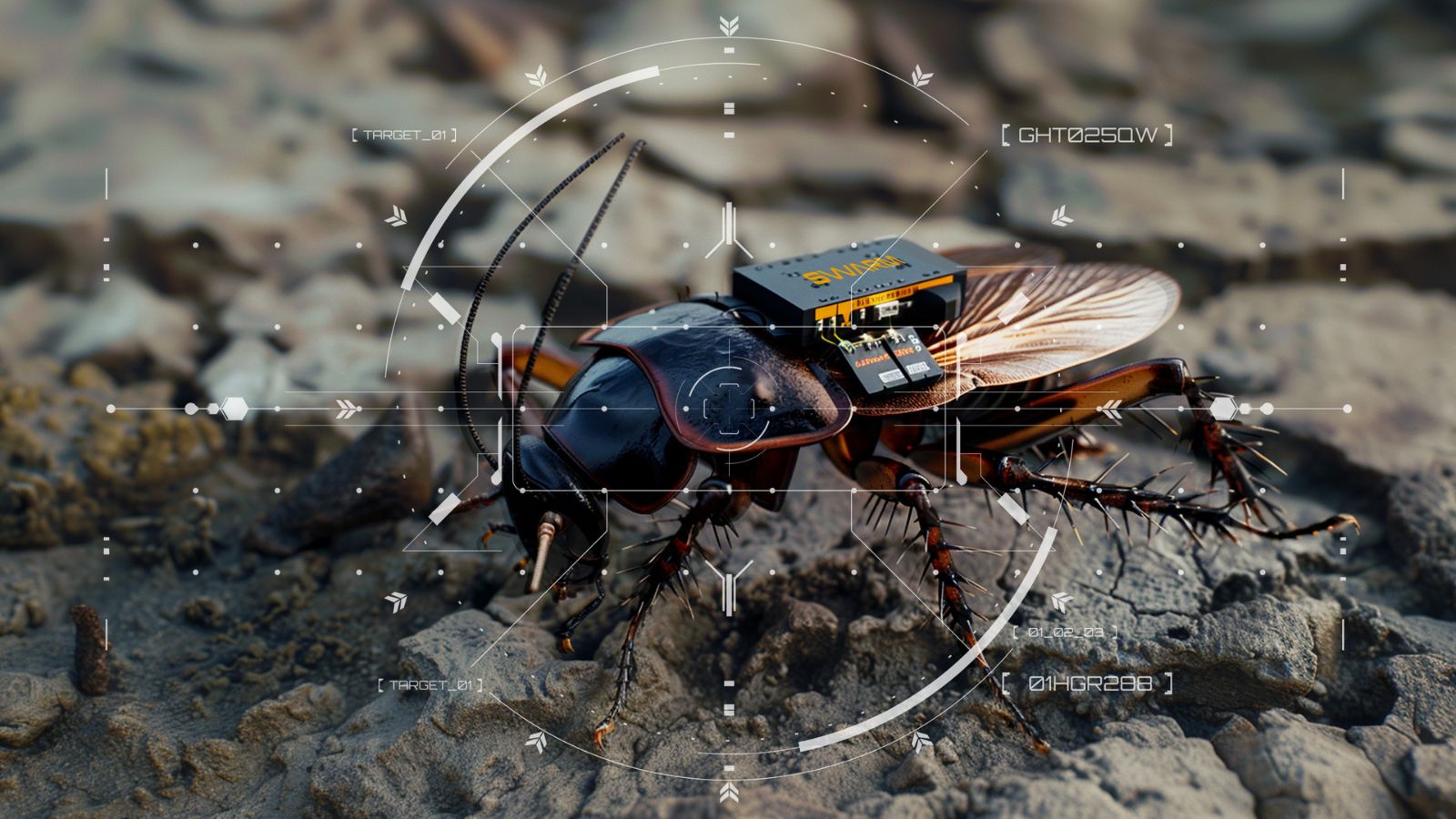
Image Source: SWARM Biotactics
What Are Cyborg Cockroaches?
The term “cyborg cockroaches” describes live insects that researchers have transformed using tiny electronic components, including sensors, micro-cameras, microphones, neural stimulation interfaces, wireless communication systems, and on-board artificial intelligence (AI) systems, to function as independent or partially independent spy devices.
The systems use insect mobility and resilience and small body size, which experts have observed in Madagascar hissing cockroaches to operate in restricted areas including rubble, tunnels, collapsed buildings and dense vegetation. The insect moves while gathering information through a system that combines remote control with preprogrammed AI behavior.
Key components typically include:
- Bioelectronic neural interfaces that influence insect movement through low-voltage stimulation.
- Modular sensor backpacks with cameras, microphones, environmental sensors (e.g., gas or temperature), and secure communication modules.
- Edge AI processing on tiny chips to pre-filter data and reduce communications load.
- Swarm-level coordination algorithms for managing groups of insects.
This hybrid approach is often referred to as physiological robotics or bio-robotics, because it uses living organisms as the locomotion and sensing platform, enhancing them with artificial systems rather than creating fully mechanical robots.
How the Technology Works
Biological Basis and Species Selection
Most cyborg reconnaissance projects use Madagascar hissing cockroaches due to desirable biological traits:
- Size and strength: These cockroaches can carry payloads suitable for miniaturized electronics without being encumbered.
- Environmental resilience: They tolerate heat, chemical exposure, radiation, and physical stress better than many mechanical platforms.
- Evolutionary mobility: Millions of years of evolution have optimized their ability to navigate complex terrain.
The insects are outfitted with ultra-lightweight backpacks weighing roughly 3–15 grams, which contain micro-electronics for sensing and communications. Researchers and engineers attach electrodes or stimulation pads that interface with the insect’s nervous system. These can induce directional behavior or other movements through carefully calibrated electrical pulses — either via a remote operator or programmed control.
AI and Swarm Coordination
Beyond individual control, AI algorithms enable collective behavior — often called swarm intelligence. Instead of operating a single insect at a time, systems can:
- Assign roles (e.g., one insect for visuals, another for communications).
- Enable autonomous group navigation through thresholds and rules of engagement.
- Allow pattern recognition within images before data is sent back, reducing bandwidth and enhancing responsiveness.
This type of distributed processing and coordination is a hallmark of advanced autonomy in robotic systems — scaled down to living agents.
Strategic and Operational Advantages
Unmatched Accessibility in Challenging Terrain
Traditional robots and drones are limited by size, energy sources, and mobility. In contrast:
- Cockroaches navigate confined and uneven spaces with ease, requiring no additional locomotion hardware.
- Biological energy systems eliminate the need for large batteries or frequent recharging.
- Low acoustic and visual signatures make them unlikely to be noticed in covert missions.
These advantages make cyborg cockroaches ideal for reconnaissance in environments where human access is too risky and mechanical robots cannot maneuver — such as collapsed infrastructure, underground facilities, or warzones.
Scalability and Persistence Through Breeding
One notable conceptual advantage touted by proponents is biological scaling. Instead of relying on factory production of machines, living organisms reproduce naturally. This could, in theory, allow large populations of units to be deployed or bred, forming persistent reconnaissance swarms without proportional manufacturing costs.
Real-World Deployments and Developments
Startup Innovation and Funding
The primary company developing this technology is SWARM Biotactics, a defense-tech startup headquartered in Kassel, Germany. Founded in 2024, the startup has secured approximately €13 million in funding, including a €10 million seed round with participation from investors such as Vertex Ventures US and Possible Ventures.
Testing and Field Trials with NATO Forces
Recent developments indicate that the technology has moved beyond laboratory prototypes into field testing and initial deployment with NATO customers, including sections of the German Armed Forces. Field-testing reportedly includes operational validation in simulated and real environments in both Europe and the U.S., marking a rare transition from experimental concept to useful military tool.
SWARM CEO Stefan Wilhelm has publicly stated that what did not exist a year ago now operates as a programmable system for paying defense customers — a rapid commercialization timeline by defense innovation standards.
Use Cases Beyond Defence
While primary interest is military intelligence, there are dual-use scenarios where bio-robotic insects could prove valuable:
Disaster Response and Search & Rescue
In collapsed buildings or rubble-filled zones after natural disasters, living reconnaissance agents could:
- Detect trapped individuals using thermal or acoustic sensors.
- Navigate debris to assess structural integrity.
- Relay environmental data back to rescue teams.
This makes them potentially useful in scenarios where mechanical robots struggle and human rescuers are at risk.
Industrial Inspection
Confined spaces inside industrial facilities — such as pipelines, storage tanks, or ventilation systems — could be inspected with minimal human risk using these biohybrid agents.
However, ethical, regulatory, and practical considerations may limit widespread adoption outside of controlled environments.
Ethical, Legal, and Safety Concerns
The use of live insects as reconnaissance platforms raises significant ethical issues:
- Animal welfare: Even if proponents assert the process is painless, animal rights advocates often challenge the concept of biological experimentation for surveillance.
- Regulation: There is little existing legal framework for bio-robotic surveillance involving living organisms.
- Dual-use misuse: Technologies designed for defense could potentially be adapted for invasive or unauthorized surveillance in civilian contexts.
Some governments and research bodies are already debating regulations on physiology-integrated systems to ensure ethical boundaries are respected.
Future Prospects and Industry Impact
Bio-robotic reconnaissance represents a unique branch of defense innovation, combining AI, robotics, and biotechnology. Potential long-term trends include:
1. Greater Autonomy Through AI
Future systems could reduce human control needs, allowing fully autonomous swarm decisions based on mission criteria.
2. Miniaturization and Payload Diversification
Research may push towards even lighter electronics and diverse sensors — such as chemical analyzers or biometric detectors — expanding mission capabilities.
3. Integration in Multi-Agent Systems
Cockroach swarms could become part of layered reconnaissance ecosystems, working alongside drones, ground robots, and sensor networks, each optimized for different environments.
Conclusion
Germany has developed AI-powered cyborg cockroaches, which create a new area for defense systems that combine biological elements with technological components. The high-concept research project has transformed into operational reconnaissance systems that military customers use during actual combat situations. The functioning robots demonstrate how contemporary military operations have transitioned to prioritize stealth and flexible operational capabilities while maintaining high-level intelligence in situations where standard equipment fails to perform. The upcoming development of this field requires organizations to create a balance between their innovative work and requirements for ethical standards, legal frameworks, and safety protocols, which must be followed throughout all aspects of their research operations.
FAQs
What are cyborg cockroaches?
They are live insects outfitted with miniaturized electronics and AI systems for controlled movement, sensing, and communications during reconnaissance missions.
How do they navigate?
Movement is influenced by neural stimulation interfaces and can be guided remotely by operators or through preprogrammed AI behaviors, with swarm coordination enhancing effectiveness.
Where are they being tested?
Field testing and early deployments have reportedly been conducted with NATO allies, including Germany and U.S. operations, validating real-world reconnaissance capabilities.
Are there civilian applications?
Yes — search-and-rescue after disasters or industrial inspections in confined spaces are potential non-military applications.
What are the ethical concerns?
Issues include animal welfare, regulation of bio-robotic intelligence systems, and potential misuse for unauthorized surveillance outside legitimate missions.