
Claude Opus 4.6 is Anthropic’s most advanced artificial intelligence model to date — a frontier large language model (LLM) optimized for deep reasoning, large-scale coding, autonomous task execution, and enterprise-grade workflows. Launched on February 5, 2026, Opus 4.6 represents a qualitative leap forward in capability, with a suite of features that push AI beyond conversational assistants into real-world professional, technical, and business tasks.
This article provides an in-depth look at Claude Opus 4.6 — its core features, technical advancements, enterprise relevance, benchmark performance, integration paths, and competitive implications.
Video Credit: Anthropic
What is Claude Opus 4.6?
Claude Opus 4.6 is Anthropic’s most advanced Opus-class AI model to date, offering enhanced reasoning, planning, and autonomous execution capabilities. It’s positioned as a premium model for coding, agentic workflows, and high-stakes enterprise tasks that require sustained, multi-step reasoning.
Key highlights include:
- A 1 million token context window in beta, enabling the model to process extremely large inputs in a single session.
- Agent Teams, allowing multiple AI agents to collaborate in parallel on large tasks.
- Hybrid reasoning that supports both fast responses and deep problem solving.
- Strong performance in coding, debugging, document analysis, and complex enterprise workflows.
Opus 4.6 is available on Claude.ai, through the Claude API, and through major cloud platforms such as Amazon Bedrock and Microsoft Foundry.
Core Innovations in Claude Opus 4.6
1. One Million Token Context Window (Beta)
One of the most transformative features of Opus 4.6 is its support for a 1-million-token context window in beta. This allows the model to ingest and reason over massive inputs — such as long technical documents, extensive codebases, or entire research reports — in a single prompt. Previous models typically supported much smaller context windows, which required large tasks to be split or chunked.
Practical benefits include:
- Processing up to book-length text or entire repository codebases without manual segmentation.
- Maintaining deeper conversational intelligence across long dialogues or research sessions.
- Reducing context “rot” where key information is lost as sessions progress.
This enhancement unlocks new possibilities for enterprise analytics, legal review, and knowledge management where long context matters. For example, legal teams analyzing lengthy contracts or financial professionals working with detailed reports and historical datasets can now keep the entire context within a single request.
2. Agent Teams for Parallel Autonomous Work
Agent Teams is another headline innovation in Opus 4.6. Rather than relying on a single agent to tackle tasks sequentially, Opus can now assign subtasks to multiple AI agents running in parallel, each independently working toward a portion of the overall objective.
This meta-coordination approach resembles a human engineering team:
- Parallel execution speeds up complex workflows.
- Agents “own” tasks but can share results and coordinate with minimal human oversight.
- The approach is particularly effective for large codebase refactors, multi-stage analysis, or comprehensive research tasks.
A notable example includes anthropic engineers demonstrating an autonomous cluster of agents building a C compiler capable of compiling Linux and other major software projects with minimal human guidance — a striking illustration of agentic collaboration in practice.
3. Adaptive Reasoning and Effort Controls
Opus 4.6 introduces adaptive thinking and effort controls, which enhance the model’s ability to allocate cognitive effort appropriately for the complexity of a task. Instead of applying a one-size-fits-all reasoning budget, the model dynamically decides:
- When to perform deeper reasoning.
- How much compute to use for slower, more complex evaluations?
- When to use fewer resources for simple tasks.
This results in faster responses for straightforward prompts and more thorough reasoning for complex questions, optimizing both cost and performance.
4. Expanded Output and Integration Capabilities
Claude Opus 4.6 supports up to 128,000 output tokens, enabling more detailed and comprehensive responses in a single API call, which is especially important for complex document generation and reporting tasks.
Cloud integrations extend Opus 4.6’s applicability:
- Amazon Bedrock offers enterprise teams access to this model for scalable production workloads.
- Microsoft Foundry provides deeper API capabilities for adaptive reasoning and richer developer controls.
These integrations make it easier for organizations to embed Opus 4.6 into existing workflows, applications, and platform ecosystems.
Benchmark and Real-World Performance
According to Anthropic’s model card and independent evaluations:
- Opus 4.6 achieves state-of-the-art results on coding and agentic benchmarks like Terminal-Bench 2.0 and HS-BigLaw Bench.
- It outperforms competitors like GPT-5.2 in coding, finance, and legal knowledge domains according to early industry reports.
- The long context performance jump is dramatic, with long-context benchmarks indicating significant improvements over prior versions.
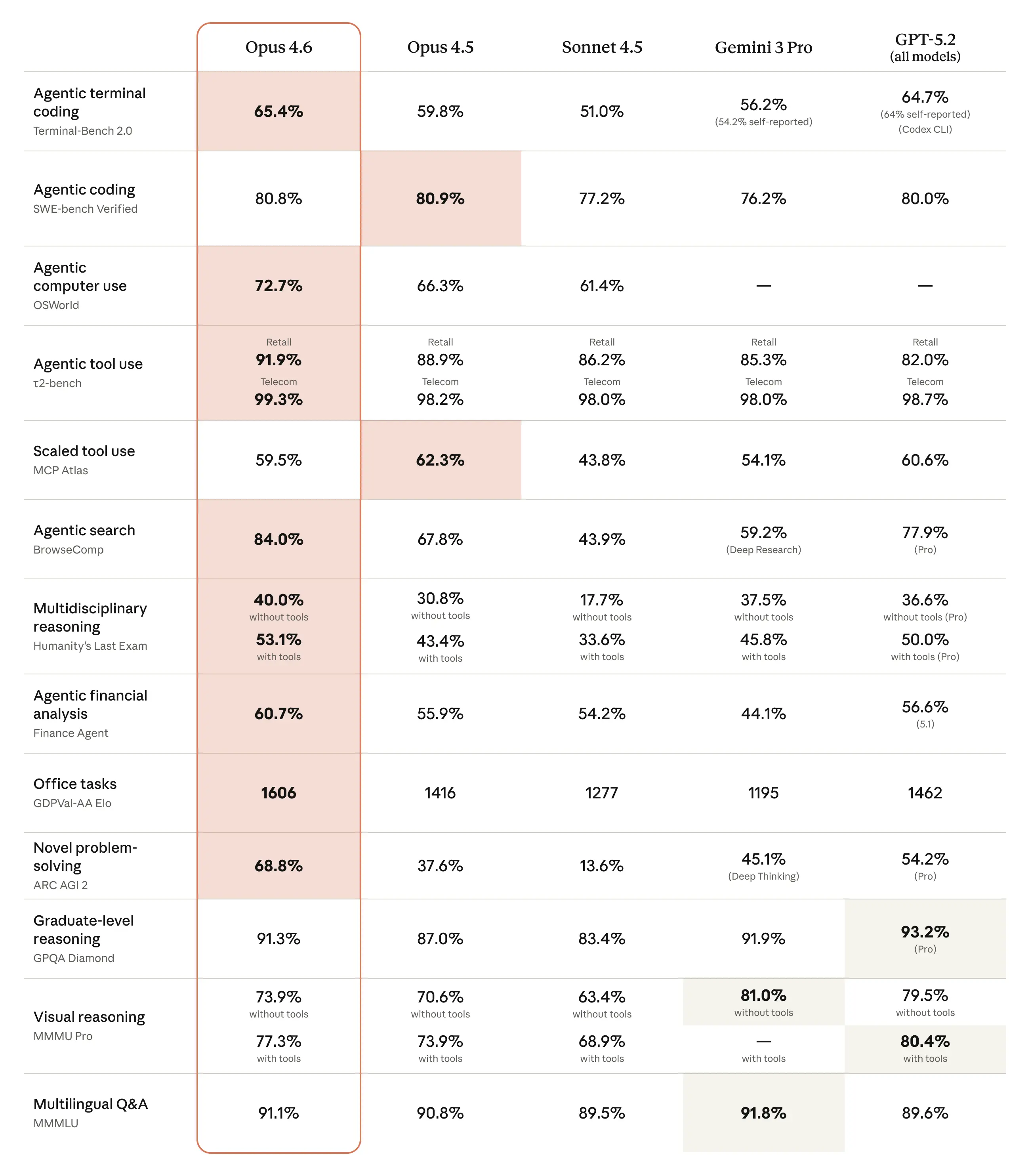
These results reflect a model that is not only more capable of handling complex tasks but also more reliable in long-running and multi-step processes.
Enterprise and Professional Use Cases
Claude Opus 4.6 is being adopted across a wide range of professional and enterprise contexts:
Software Development and Engineering
For developers, Opus 4.6 offers:
- Production-ready code generation and debugging.
- Autonomous refactoring and legacy code handling.
- Parallel agentic workflows to break down large engineering efforts.
Case in point: engineers using Opus 4.6 report significant improvements in refactoring and cross-file comprehension, helping streamline complex software maintenance.
Enterprise Workflow Automation
Businesses are deploying Opus 4.6 to:
- Automate long-running tasks such as financial modeling, spreadsheet analysis, and report generation.
- Integrate into office tools like PowerPoint and Excel, with research preview features that assist with slide creation or data processing.
These capabilities support knowledge workers by embedding AI directly within familiar productivity environments.
Legal and Financial Intelligence
The model exhibits strong performance in deep text interpretation, legal reasoning, and research workflows. Benchmarks show high accuracy in legal domain evaluations, helping improve due diligence and document analysis.
Financial analysts can also use Opus 4.6 to generate insights from large datasets that previously required extensive manual work, contributing to faster decision cycles.
AI Agents and Autonomous Systems
The agent team’s capability makes Opus 4.6 a strong candidate for building autonomous AI assistants capable of managing nuanced tasks without constant human input. This can include:
- Coordinating multi-stage business processes.
- Running internal workflows with error detection.
These attributes make Opus 4.6 suitable for the next generation of enterprise AI automation.
Competitive Context and Market Impact
Claude Opus 4.6 has been released in a competitive landscape, with rivals like OpenAI simultaneously launching advanced models such as GPT-5.3-Codex.
The news of Opus 4.6’s capabilities has had a perceptible impact on markets, with some legacy software providers experiencing stock sell-offs as investors recalibrate expectations around AI’s capacity to automate traditional software and data work.
Anthropic’s focus on enterprise readiness, safety alignment, and contextual depth distinguishes its models in a crowded field.
Safety, Reliability, and Trust
Anthropic emphasizes trust and safety as core design principles for Opus 4.6. Extensive internal testing with external partners has aimed to reduce misaligned behavior and ensure output reliability.
The company continues to refine safety protocols that govern harmful or abusive interactions and to embed safeguards into product usage, building on prior updates that directly addressed misuse scenarios.
Claude Opus 4.6: Pricing and Availability
Opus 4.6 is available to enterprise and developer audiences:
- Pro, Max, Team, and Enterprise users on Claude.ai.
- Accessible via the Claude API.
- Deployed on Amazon Bedrock and Microsoft Foundry.
The base pricing starts at around $5 per million input tokens and $25 per million output tokens, with discounts available through prompt caching and batch processing strategies.
Conclusion
Claude Opus 4.6 represents a significant milestone in generative AI — one that expands the horizon of what large language models can achieve in complex, long-running, and enterprise-scale scenarios. The combination of its extensive contextual understanding, its ability to manage multiple agents and its capacity to evolve its reasoning skills makes the system suitable for actual work in software development, financial analysis, legal research and automated business processes.
The competitive analysis of Opus 4.6, together with its demonstration of practical benefits, enables organizations and developers to understand how this model relates to current AI trends, which range from deep automation to interdisciplinary task orchestration, and how it can be integrated into their work processes.
FAQs
What is Claude Opus 4.6?
Claude Opus 4.6 is Anthropic’s latest and most advanced AI model, designed for coding, autonomous workflows, and enterprise-grade tasks, with extended context support and agentic collaboration features.
How does the 1 million token context help?
It allows the model to process massive inputs — such as entire codebases, long research documents, and extensive dialogues — in a single session without splitting tasks.
What are “Agent Teams”?
Agent Teams are a new feature that enables multiple AI agents to work together in parallel on different parts of a large task, improving speed and coordination.
Can Opus 4.6 replace human developers?
While Opus 4.6 significantly accelerates coding and debugging, it is designed to augment human engineers — reducing routine work while humans retain strategic control.
Is Opus 4.6 safe to use in enterprise settings?
Anthropic has tested the model extensively to minimize misaligned behavior and embedded safety protocols, making it suitable for enterprise contexts with appropriate governance.
Where can I access Claude Opus 4.6?
It’s available on Claude.ai, via the Claude API, and through major cloud platforms such as Amazon Bedrock and Microsoft Foundry.