
Towards the end of 2025, Google launched Google Code Wiki, a very effective tool aimed at removing one of the oldest and hardest bottlenecks in software development: the comprehension of the existing code. Code Wiki, instead of depending on static documentation that becomes outdated very soon, applies automated analysis and AI intelligence to create constantly updated, interactive documentation for complete code repositories. This change makes understanding code to be an easy, fast, and accurate practice instead of a manual, slow, and error-prone task.
This article offers an in-depth look at what Google Code Wiki does, how it works, its implications for development workflows and teams, real-world use cases, adoption and considerations.
The Code Comprehension Challenge in Software Development
For most development teams, particularly those managing large or legacy codebases, one of the biggest drains on productivity is comprehending existing code. Analysts report that developers spend 30-40% of their time just understanding code they didn’t write themselves — a task compounded by poor, outdated, or missing documentation.
Traditional practices rely on:
- Manual documentation written and maintained by developers.
- Sparse comments that often lag behind code changes.
- Search and navigation tools that show raw code but little explanation of context.
In many organizations, this results in slower onboarding, increased risk during handovers, and a disproportionate share of time spent deciphering code instead of building or improving it. Code Wiki seeks to change this paradigm.
What Is Google Code Wiki?
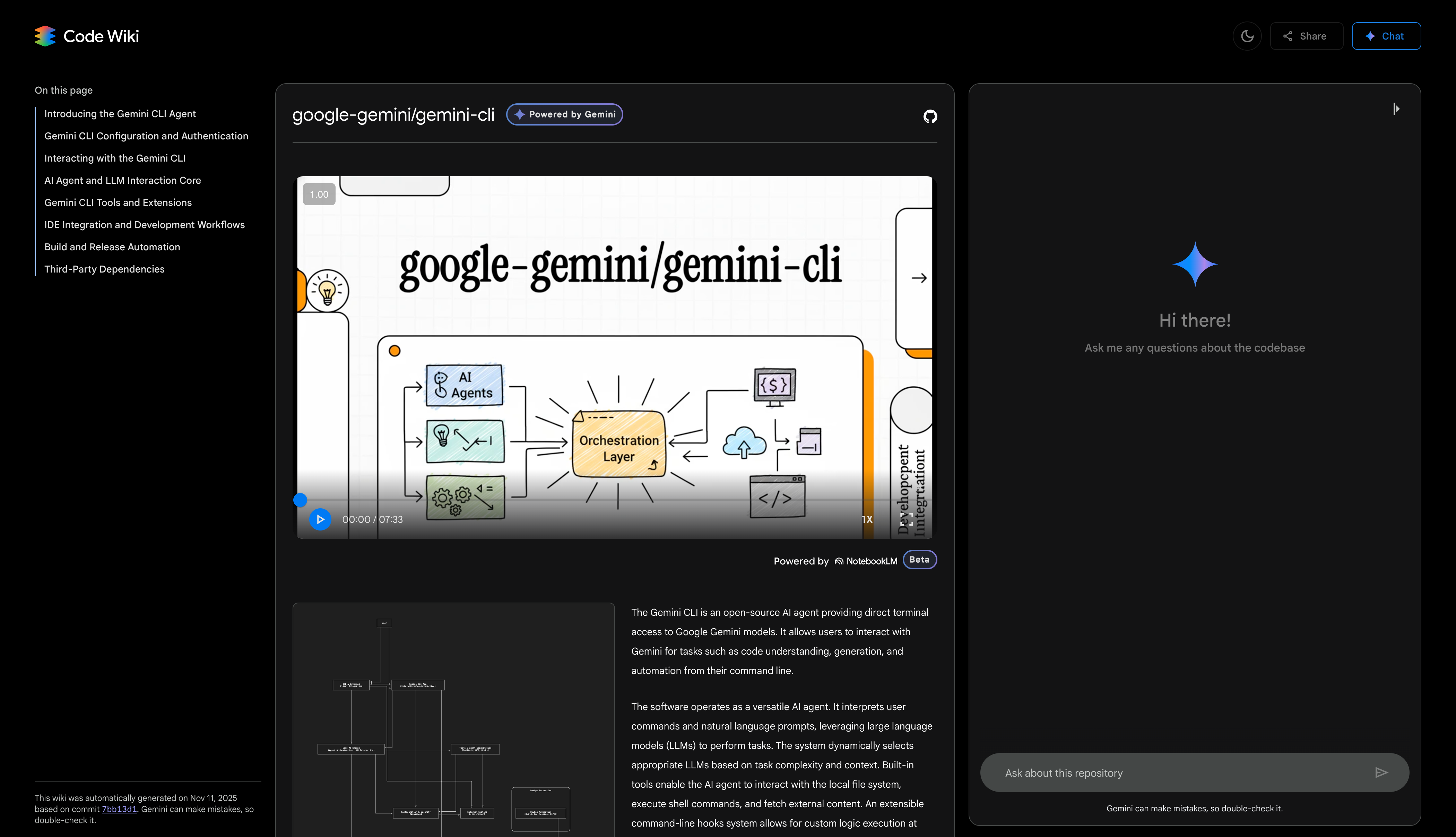
Google Code Wiki is an AI-driven documentation platform that automatically generates, updates, and hosts a structured wiki for any code repository it ingests. Unlike conventional docs, this wiki evolves in lockstep with the code — automatically refreshing after every commit to keep explanations, diagrams, and references aligned with the latest state of the repository.
At its core, Code Wiki combines three major elements:
- Automated Documentation Generation — Code Wiki scans every file, function, and module, producing structured explanations of what each part of the code does.
- Dynamic Visualizations — The system creates architecture, class, and sequence diagrams that mirror the code structure and refresh them as changes occur.
- Gemini-Powered Contextual Chat — Integrated into each wiki page is a conversational AI assistant that answers natural language questions about the codebase, drawing on the current documentation as its knowledge source.
This combination yields a documentation experience that is interactive, accurate, and meaningful for developers at any skill level.
How Google Code Wiki Works: A Deep Dive
The operational model of Google Code Wiki is built around continuous code analysis and intelligent content generation:
Repository Scanning and Analysis
Whenever a codebase is shared with Code Wiki, the system performs a full static analysis of the repository. It examines:
- Source files
- Class hierarchies
- Dependencies
- Function definitions and invocations
- Separation of concerns and architectural patterns
This whole-repo understanding enables the generation of documentation that captures not only individual elements but also how they relate to one another.
Continuous Updates with Every Commit
One of the biggest improvements over static doc systems is that Code Wiki regenerates documentation after each commit. This eliminates documentation drift — the problem where docs become inaccurate as the code evolves — and ensures that what developers read always reflects the most recent code state.
AI-Powered Chat Integration
Every Code Wiki includes an intelligent assistant powered by Google’s Gemini model. But unlike generic AI helpers, this chat interface understands the specific repository. It uses the up-to-date wiki as the context for its answers, enabling interactive Q&A such as:
- “How does the authentication flow handle token refresh?”
- “Where is the database connection pool implemented?”
- “What are the dependencies for the user service module?”
The AI agent also links responses directly to relevant sections in the code, diagrams, and definitions, blurring the line between documentation and exploration.
Interactive Navigation and Diagram Support
Instead of disjointed text files, Code Wiki presents documentation that is:
- Hyperlinked — Every explanation links back to the precise file or code segment.
- Visual — Architecture, class, and sequence diagrams show how components fit together.
- Explorable — Users can navigate seamlessly between high-level context and detailed implementation.
These visual and navigational elements make it easier to trace logic and understand complex interdependencies in large systems.
Public Preview and Private Repo Support
Currently, Code Wiki is available in public preview for open-source repositories hosted on platforms like GitHub via the Code Wiki website. Google is also developing a Gemini CLI extension that lets organizations run the same automated documentation generation for private or internal repositories — a critical feature for enterprise adoption.
Key Features and Capabilities Explained
Automated, Always-Fresh Documentation
Manual documentation is a liability because it becomes outdated the moment code is modified. Code Wiki flips this model with code-driven documentation that stays current without human intervention. Every commit triggers regeneration of docs and diagrams — a major leap forward in documentation maintenance.
Context-Aware Gemini Q&A
Traditional code search tools may help you find where a function is defined. Code Wiki’s chat goes further: it interprets code semantics and can answer questions like a developer who’s deeply familiar with the repo. This makes onboarding and auditing far more efficient.
Interactive Navigation
Instead of reading fragmented or loosely linked files, developers can click through from concept to implementation without leaving the documentation context. The hyperlinking between documentation and code enables fluid exploration.
Live Visual Diagrams
Modern codebases often involve complex relationships among modules, microservices, or classes. Auto-generated diagrams, updated on every code change, help users visualize structure and behavior — revealing patterns that text alone may obscure.
Support for Private Code via CLI (Upcoming)
The Gemini CLI extension under development will bring Code Wiki’s automation to private repositories, enabling companies to keep documentation within secure environments — an essential consideration for regulated industries and intellectual property protection.
Comparing Google Code Wiki with Traditional Documentation
| Feature | Traditional Documentation | Google Code Wiki |
| Creation | Manual | Automated |
| Accuracy Over Time | Prone to outdated content | Always current after commits |
| Navigation | Basic or fragmented | Hyperlinks + diagrams |
| Search | Text search limited | AI contextual understanding |
| Q&A Support | None | Gemini-powered chat |
| Effort | High maintenance | Minimal developer input |
This comparison highlights how Code Wiki addresses the most persistent pain points of manual documentation systems.
Real-World Use Cases and Benefits
Accelerating Onboarding
New team members often spend days or weeks reading docs, running code locally, and hunting for contextual cues. With Code Wiki, onboarding time can shrink dramatically because developers can query the codebase directly and get instant, repository-specific explanations.
Legacy Code Understanding
Teams frequently inherit legacy systems with incomplete or missing documentation. Code Wiki automatically infers structure and behavior, allowing developers to ramp up faster and reduce reliance on tribal knowledge left with former team members.
Cross-Team Collaboration
When teams work on interconnected services, uniform and accurate documentation helps reduce miscommunication. Code Wiki’s integrated diagrams and hyperlinked navigation make it easier to understand how systems interact across boundaries.
Open Source Contribution
Open source projects often struggle with documentation quality and freshness. Code Wiki’s public preview gives contributors an always-fresh guide to the codebase they’re exploring, lowering barriers to entry and enhancing project sustainability.
Industry Implications and Strategic Value
Redefining Developer Experience
Documentation has historically been treated as a necessary overhead. Code Wiki reframes documentation as a byproduct of code itself, driven by AI and kept current automatically. This minimizes manual effort and repositions developers’ time toward value creation rather than code comprehension.
Enterprise and Compliance Readiness
For regulated industries and enterprise teams, consistent documentation is not just a developer “nice-to-have” — it’s a compliance requirement. The upcoming Gemini CLI extension that runs Code Wiki locally behind the firewall enables companies to maintain documentation standards while keeping code confidential.
Evolution of Dev Tools
Industry adoption of tools like Code Wiki reflects a broader transition from static developer utilities to AI-enhanced continuously adaptive systems. This trend is in keeping with the rise of AI-aided development environments, automated code assistants, and agent-like automation in build pipelines.
Implementation Considerations
While Code Wiki’s public preview makes it accessible for open-source exploration, organizations considering internal adoption should plan around several factors:
- Language and Framework Support: Early previews focus on popular languages; teams using niche or proprietary languages may face gaps.
- Security and Compliance: When running documentation tools on private repos, it’s essential to ensure the CLI extension aligns with internal security policies.
- Integration with Existing Tools: Teams should evaluate how Code Wiki fits with existing documentation workflows, issue trackers, and code review processes.
Conclusion
Google Code Wiki is a significant change in the way that developers work with and understand code. By automating documentation, producing live diagrams and adding an AI-powered contextual chat, Code Wiki solves one of the biggest time consuming problems in software development. Its impact includes better onboarding, increased understanding of legacy, and more effective collaboration between teams. Although still in public preview particularly for the private codes, Code Wiki is a good example of how artificial intelligence can be leveraged to change the way development productivity and diminishes the cognitive load on the developer, allowing development teams to spend their time writing the code instead of trying to decipher the code.
FAQs
What is Google Code Wiki?
Google Code Wiki is an AI-driven documentation platform that automatically generates and updates structured, interactive documentation for code repositories, powered by Gemini AI and hosted in public preview.
How does Google Code Wiki stay up-to-date?
Code Wiki scans the full codebase after each commit and regenerates its documentation and diagrams, ensuring that what users see always matches the current code.
Can Code Wiki be used for private repositories?
A Gemini CLI extension is in development that will allow teams to run Code Wiki locally and securely on private repositories, but it currently operates on public repos in preview.
Does Code Wiki replace human-written documentation?
It automates much of the documentation process, particularly for code structure and explanation, but understanding why architectural decisions were made may still benefit from human context.
What kinds of diagrams does Code Wiki generate?
Code Wiki auto-generates architecture, class, and sequence diagrams that reflect relationships and flow within the codebase.
How does the integrated AI chat work?
The integrated chat uses Gemini AI and the current wiki content as its knowledge base to answer natural language questions specific to the repository.