
Health in ChatGPT is a dedicated feature that lets eligible U.S. users securely connect medical records, Apple Health, and select wellness apps to ChatGPT so it can answer health questions using their own personal context. Rolled out nationally on July 23, 2026, it is designed to help people understand lab results, prepare for appointments, and track patterns over time — while explicitly supporting, not replacing, care from licensed clinicians.
This guide breaks down exactly how Health in ChatGPT works, how to use ChatGPT for health questions safely, what the research says about its accuracy, and how it compares to other AI health tools like Google Gemini.
This article covers:
What Health in ChatGPT is and how it works with medical records, Apple Health, and wellness apps
How to connect your health data, manage permissions, and use personalized health insights safely
Key features, including lab result explanations, appointment preparation, health trend tracking, and medical record summaries
Privacy, security, and data protection, including encryption, permissions, memory settings, and data deletion
Eligibility and availability, including supported countries, platforms, and ChatGPT plans
The AI models powering Health in ChatGPT and how OpenAI evaluates medical accuracy and safety
Step-by-step guide to using ChatGPT for health questions responsibly
ChatGPT vs. Google Gemini and other AI health tools, including features, strengths, and limitations
Research on ChatGPT's medical accuracy, including comparisons with physicians and current clinical evidence
Limitations, risks, FAQs, and whether Health in ChatGPT is the right tool for your healthcare needs
What Is the Health Feature in ChatGPT?
Health in ChatGPT is a purpose-built experience inside ChatGPT that connects your personal health information — medical records, Apple Health data, and wellness app data — directly to the model, so its answers are grounded in your actual health history rather than generic information.
Instead of typing out your medications, lab values, or recent diagnoses every time you have a question, ChatGPT can reference what you've already connected. It can compare a new lab result with a previous one, summarize what has changed since your last visit, or relate your sleep and activity data to a fitness goal.
The feature isn't new territory for OpenAI, but this July 2026 update marks a major shift. According to OpenAI, health is already one of the most common reasons people use ChatGPT: more than 300 million people ask health-related questions every week, up from roughly 230 million when a limited pilot launched earlier in the year.
Why OpenAI Built It
OpenAI's stated rationale is straightforward: healthcare information is scattered. A person's medical history typically lives across hospital patient portals, pharmacy apps, wearables, PDFs of lab results, and handwritten notes from a rushed appointment. Ashley Alexander, OpenAI's VP of Health Products, pointed out during a media briefing that the average U.S. doctor's visit lasts under 15 minutes, leaving patients to piece together fragmented information on their own afterward.
Health in ChatGPT was built to close that gap — not by replacing physicians, but by helping people organize, understand, and act on the information they already have.
How Health in ChatGPT Works
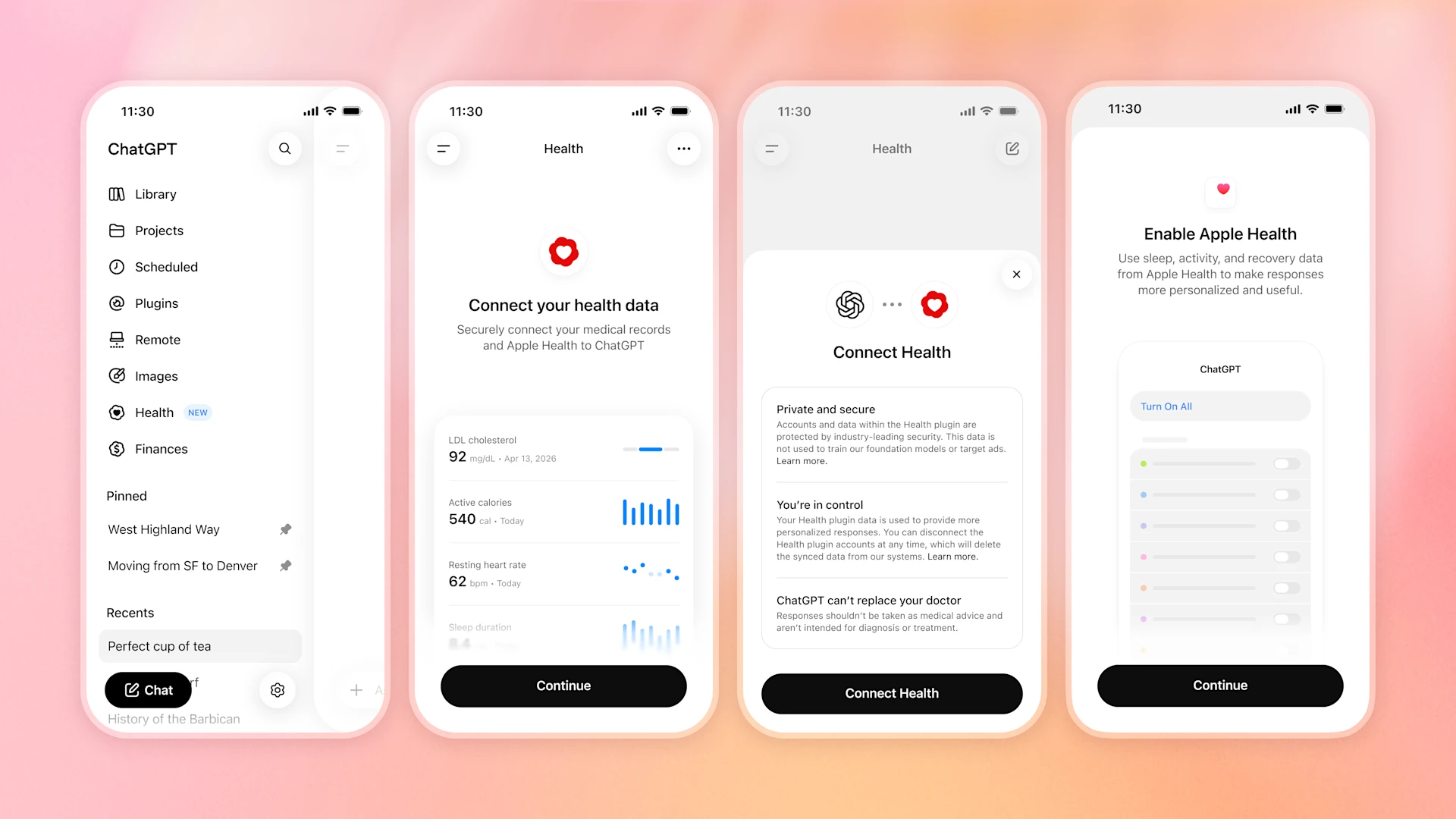
Image Credit: OpenAI
Connecting Your Health Data
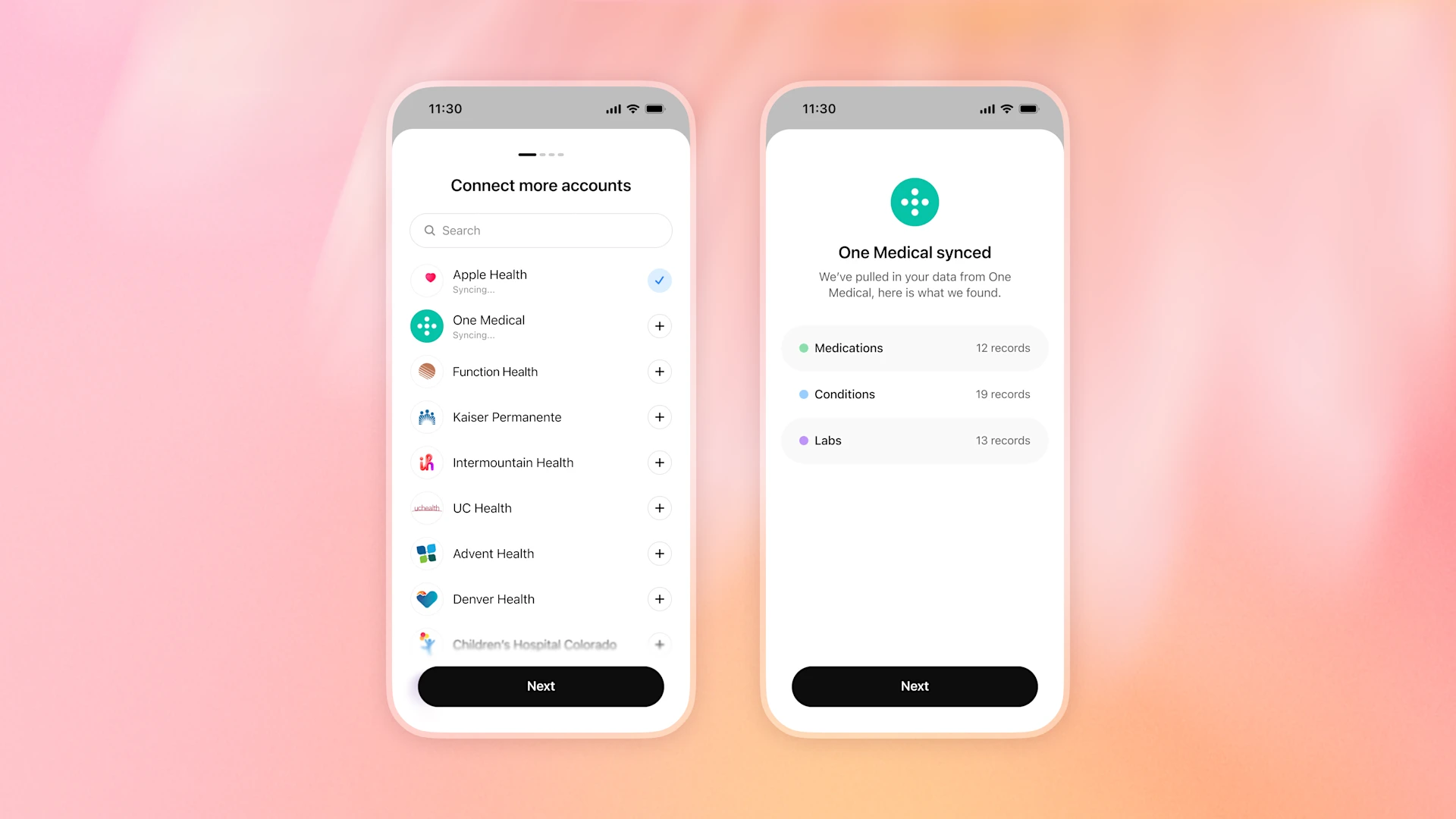
Users can link three main categories of information:
Apple Health – movement, sleep, workouts, and any wearable or fitness app that syncs into Apple's Health app (requires iOS).
Electronic medical records (EHR) – supported U.S. hospital systems, One Medical, and Function Health, connected by signing into each provider's portal.
Third-party wellness apps – including services like Peloton, MyFitnessPal, AllTrails, Instacart, and Weight Watchers, which can be enabled individually inside Health.
None of this is required to use ChatGPT for general health questions — you can still ask about symptoms, medications, or wellness topics without connecting anything. Connecting data simply makes responses more personalized.
The Permission Model
By default, ChatGPT asks for permission every time it wants to use your connected health data to personalize an answer. You can approve access one time or choose "always allow," which turns off future prompts. This setting lives under Settings > Plugins > Health and can be changed or revoked at any time.
You can also type @Health directly into a message to explicitly pull your connected health context into that conversation.
One Home Base, Used Everywhere
Earlier versions of the feature required users to open a separate "Health" space to get grounded answers. OpenAI found that over 70% of health-related conversations were happening in normal chats — while planning meals, for instance, someone might want ChatGPT to remember a food allergy. The redesigned version removes that friction: your connected health information can now inform any conversation, not just ones started inside the Health tab. The Health section in the sidebar remains the control center where you view trends, browse synced records, manage connected accounts, and revisit past health-related chats.
Key Things You Can Do With Health in ChatGPT
Understand lab results — compare new bloodwork against previous results and get plain-language explanations of what changed.
Prepare for appointments — generate a list of questions to ask your doctor based on your history and symptoms.
Track patterns over time — connect sleep, activity, and recovery data to spot trends rather than isolated data points.
Plan meals and workouts — get suggestions that automatically factor in allergies, dietary restrictions, or a recent injury.
Make sense of visit notes — turn clinical shorthand and jargon into language a non-specialist can actually use.
Privacy, Security, and Data Control
Because health information is uniquely sensitive, OpenAI has layered additional protections on top of ChatGPT's standard security architecture:
No training, no advertising. Connected medical records, Apple Health data, and any conversation that uses them are excluded from foundation model training and are never used to target ads — regardless of your general ChatGPT data settings.
Encryption at rest and in transit. All ChatGPT conversations are encrypted by default, and Health information receives additional, purpose-built encryption and isolation.
You control access. Every use of your connected data requires permission unless you switch to "always allow." You can disconnect any account at any time from Health > Accounts, after which synced data is deleted from OpenAI's systems within 30 days.
Memory stays optional. ChatGPT can create memories from your Health conversations to personalize future chats, but memories are never created directly from raw medical records or Apple Health data. You can avoid memory entirely using Temporary Chat or by turning memory off in settings.
Extra safeguards for sensitive sharing. If ChatGPT is about to share health-derived information through a connected app — for example, sending a training plan built from your Apple Health data to a workout partner — additional checks confirm the sharing matches what you actually asked for, and some actions require explicit confirmation.
OpenAI says it continues to run dedicated red-team testing focused specifically on connected health data to strengthen these protections over time.
Who Can Use Health in ChatGPT? (Eligibility)
Requirement | Detail |
Location | United States only |
Age | 18 and older |
Plans | Free, Go, Plus, and Pro |
Platforms | Web and iOS |
Availability | Rolling out gradually; not yet available in Codex |
If you don't see the Health tab yet, it likely hasn't reached your account in the rollout.
The AI Models Behind Health in ChatGPT
OpenAI trains its models specifically for health conversations, working with physicians to build realistic scenarios and detailed grading rubrics that assess accuracy, safety, clarity, context awareness, and — critically — whether the model recognizes when a situation needs urgent, in-person care.
GPT-5.5 Instant, available to free users, brought a meaningful jump in the model's ability to recognize when urgent care may be needed, ask clarifying questions, and simplify complex medical information.
GPT-5.6 Sol, available to paid plans, is described by OpenAI as its strongest health model yet, with better performance on tasks that require reasoning across multiple connected data points, such as comparing changes in lab values over several visits.
To benchmark progress, OpenAI collaborates with physicians across dozens of specialties and more than 60 countries and evaluates models against HealthBench Professional, an independent benchmark for difficult, real-world health scenarios. OpenAI reports that every GPT-5.6 model outperformed GPT-5.5 on this benchmark. Even so, OpenAI is direct about the limits: it states plainly that ChatGPT can still make mistakes and does not replace the judgment of qualified medical professionals.
How to Use ChatGPT for Health Issues (Step-by-Step)
If you want to use ChatGPT for health questions responsibly, a few practices make a real difference:
Start specific, not vague. "Explain why my ALT level went from 22 to 48" gets a far more useful answer than "are my labs okay?"
Connect relevant records if comfortable. This lets ChatGPT reference actual values instead of guessing at context, and you can review or remove anything it pulls in.
Use it to prepare, not to self-diagnose. Ask it to help you build a list of questions before an appointment, or to explain a diagnosis you've already received in plainer terms.
Ask it to flag uncertainty. A well-prompted response should tell you when something is outside its confidence or when it can't rule out a serious cause.
Verify anything important. Cross-check dosages, interactions, or next steps with a pharmacist or physician, especially before changing medication or treatment.
Never use it for emergencies. Chest pain, difficulty breathing, signs of stroke, severe bleeding, or suicidal thoughts require immediate professional help — call your local emergency number or go to an emergency department. Do not wait on an AI response in an acute crisis.
Keep sensitive sharing intentional. Review permission prompts before allowing an app or connector to use health-derived context.
Which AI Is Best for Health? ChatGPT vs. Gemini vs. Others
There is no single "best" AI for every health need — the right tool depends on what you're trying to do.
ChatGPT currently has the most fully built-out consumer health experience, with direct medical record integration, Apple Health syncing, and models specifically tuned and benchmarked for health conversations through HealthBench Professional.
Google Gemini leans on Google's search index and ecosystem. Google has invested heavily in clinical-grade research models like MedGemma for imaging and pathology analysis, and Gemini has added mental-health-specific guardrails aimed at avoiding reinforcement of harmful beliefs. For everyday consumers, though, Gemini's health capabilities are more spread across specialized tools than unified into one consumer feature.
Specialized medical AI tools (used mostly by clinicians and hospitals), such as Google's AMIE research model or hospital-embedded systems, are built and validated for narrower clinical tasks rather than general consumer use.
For everyday personal use — organizing your own records, preparing for appointments, and getting plain-language explanations — Health in ChatGPT is currently the most consumer-ready option. For clinical-grade image analysis or enterprise healthcare workflows, Google's specialized medical models are more purpose-built. Neither should be treated as a replacement for a licensed physician.
Does ChatGPT Give Good Medical Advice?
Often, yes — particularly for explaining concepts, summarizing information, and generating differential diagnoses in controlled research settings. But "good" needs context. Peer-reviewed research shows a consistent pattern: AI models tend to perform strongly on structured diagnostic reasoning tasks, but real-world judgment — weighing ambiguous symptoms, knowing a patient's full history, and deciding on treatment — still leans in favor of experienced clinicians.
A widely cited JAMA Network Open study gave 50 physicians six especially difficult, previously unpublished cases. Physicians using only conventional resources scored a median of about 74%; those given ChatGPT as an assistant scored only marginally higher, around 76%, largely because many doctors disregarded the AI's suggestions when they conflicted with their own instinct. ChatGPT working entirely on its own, however, reached a median accuracy of roughly 90–92% on the same cases.
That pattern isn't limited to one study. A 2025 evaluation of Google's AMIE model in Nature found it identified the correct diagnosis in its differential list 59% of the time on complex real-world cases, compared with 34% for unassisted clinicians. An April 2026 analysis of OpenAI's o1 model reported roughly 78% accuracy on complex diagnostic cases and found it outperformed experienced physicians on real emergency-department cases.
At the same time, a larger 2025 systematic review and meta-analysis covering 83 studies found no statistically significant overall difference between generative AI models and physicians on diagnostic accuracy. And a Stanford-affiliated benchmark scoring 20 models and four clinical AI tools across 1,100 cases found that following AI-generated advice directly carried a risk of serious harm in about a quarter of cases — most often because the AI failed to flag something dangerous, not because it invented false information. Separately, a 2025 physician survey by Sermo found that 94% of doctors had concerns about patients relying on AI tools for medical advice, citing risks of misdiagnosis or delayed care.
The takeaway: ChatGPT can be genuinely useful for understanding your health and preparing for care, but it performs best as a second opinion and explainer, not as a sole source of medical decision-making.
Is ChatGPT More Accurate Than Doctors?
On narrow, well-defined diagnostic puzzles — the kind used in medical journals and case competitions — multiple studies have found ChatGPT and similar models matching or exceeding physician accuracy. That is a genuinely important and well-documented finding.
But diagnostic-puzzle accuracy is not the same as being "more accurate than doctors" in practice. Real clinical care involves physical examination, longitudinal knowledge of a patient, follow-up testing, and treatment decisions that weigh risk, cost, and a patient's personal circumstances — areas where physicians still outperform AI. Doctors also build what researchers call "illness scripts": pattern-recognition shortcuts refined over years of hands-on experience with real patients, something a text-based model cannot replicate.
The most accurate framing, supported by the research above, is this: ChatGPT can match or exceed physicians on isolated diagnostic reasoning tasks, but it is not a substitute for the full scope of clinical judgment, physical care, and accountability a licensed doctor provides. OpenAI itself frames Health in ChatGPT the same way — as a tool to support, not replace, professional care.
Limitations and Risks to Keep in Mind
AI can still make mistakes, including confidently stated but incorrect information.
It cannot examine you. No AI chatbot can listen to your lungs, order imaging, or run bloodwork.
Omission is a bigger risk than fabrication. Research suggests the most dangerous failure mode isn't the AI inventing false facts — it's failing to flag something urgent.
Regulatory and legal scrutiny is increasing. As AI health tools scale to hundreds of millions of users, lawsuits and regulatory attention around AI-generated health and mental-health advice have grown, prompting companies including OpenAI and Google to publicly reinforce safety guardrails.
Data currency matters. Connected medical records may not always be current — for example, a medication might still appear after you've stopped taking it — so always double-check important details against the original source.
The Bigger Picture: Where AI in Healthcare Is Headed
Health in ChatGPT is part of a much larger shift. Google has been building out clinical and imaging-focused models like MedGemma alongside Gemini's consumer-facing mental health guardrails. Hospitals and health systems are piloting AI for tasks like summarizing clinician notes and comparing longitudinal imaging. Surveys show younger users, in particular, are turning to AI chatbots not just for symptom questions but for general emotional and wellness support — a trend that has pushed both OpenAI and Google to invest heavily in safety testing, crisis-response behavior, and clearer disclaimers.
The direction is clear: AI is increasingly acting as a bridge between fragmented health data and the person trying to make sense of it — a role that complements, rather than competes with, the clinicians who ultimately provide care.
FAQs
What is the health feature in ChatGPT?
Health in ChatGPT is a dedicated feature that lets eligible U.S. users securely connect medical records, Apple Health, and select wellness apps so ChatGPT can give more personalized, context-aware answers to health questions. It's designed to help people understand test results, prepare for appointments, and track health patterns — while supporting, not replacing, care from doctors.
How to use ChatGPT for health issues?
Ask specific questions, connect relevant health data if you're comfortable doing so, use it to prepare for appointments and understand results rather than to self-diagnose, ask it to flag uncertainty, and always verify important information with a licensed professional. Never use it in place of emergency care.
Which AI is best for health?
For general consumer use — organizing personal health data, explaining results, and preparing for appointments — Health in ChatGPT currently offers the most complete, unified experience. Google Gemini and specialized models like MedGemma are strong in areas such as imaging analysis and ecosystem integration but are less consolidated into a single consumer health feature. The right choice depends on whether you need everyday personal support or clinical-grade specialized analysis.
Does ChatGPT give good medical advice?
It can, especially for explaining conditions, summarizing records, and generating possible diagnoses — studies have shown high accuracy on structured diagnostic cases. However, research also shows it can miss flagging serious issues in a meaningful share of cases, so its advice should be treated as a helpful second opinion, not a final answer.
Is ChatGPT more accurate than doctors?
On isolated diagnostic reasoning tasks, several studies show ChatGPT matching or outperforming physicians. But real-world medical care involves physical examination, ongoing patient relationships, and treatment decisions that go beyond diagnosis — areas where physicians remain essential. ChatGPT is best understood as a support tool, not a replacement for a doctor.