
Moonshot AI has spent the better part of two years turning "open-weight" from a footnote into a genuine challenge to closed frontier labs. With Kimi K3, the Beijing-based company has taken its boldest step yet — a 2.8-trillion-parameter model that Moonshot describes as the world's first open 3T-class system. It arrives with native multimodality, a 1-million-token context window, and coding results that go far beyond synthetic benchmarks into real engineering work: kernel optimization, chip design, and full-scale scientific research pipelines.
This guide breaks down everything worth knowing about Kimi K3 — what it is, how it's built, what it costs, how it stacks up against Moonshot's own Kimi K2.6 and Kimi K2.7 lineage, and how to actually start using it through Kimi Code or the Kimi API.
This article covers:
What Kimi K3 is and why it matters
Kimi K3's architecture: KDA, AttnRes, and Stable LatentMoE explained
Release date, open weights, and availability
How Kimi K3's thinking mode and 1M-token context work
API pricing, benchmarks, and real-world engineering results
Kimi K3 vs. Kimi K2.7 Code vs. Kimi K2.6
Coding, research, and multimodal use cases
How to use Kimi K3 with Kimi Code and the Kimi API
Membership plans, documentation, and self-hosting
Limitations, FAQs, and whether Kimi K3 is worth using
What Is Kimi K3?
Kimi K3 is Moonshot AI's flagship large language model, released on July 16, 2026, as the newest and most capable entry in the Kimi model family. It is built on two new architectural components — Kimi Delta Attention (KDA) and Attention Residuals (AttnRes) — and pairs them with a heavily sparse Mixture-of-Experts (MoE) design that activates just 16 of 896 experts per token. The result is a model with 2.8 trillion total parameters, native vision understanding, and a 1-million-token context window, positioned by Moonshot as an open-weight system built specifically for long-horizon coding, agentic knowledge work, and complex reasoning.
Moonshot is careful to frame K3's standing accurately: the company states that its overall performance still trails the strongest proprietary systems, naming Claude Fable 5 and GPT-5.6 Sol specifically, but that K3 shows frontier-level results across its internal evaluation suite and consistently outperforms the other open and proprietary models it was tested against. In short, K3 isn't being marketed as the single best model in the world — it's being marketed as the best open model at the frontier, and one of the most cost-efficient ways to get frontier-adjacent performance.
Kimi K3 Release Date
Kimi K3 went live on July 16, 2026, and is immediately usable through Kimi.com, the Kimi Work desktop app, Kimi Code in the terminal, and the Kimi API. Moonshot has confirmed that the full model weights — which will make Kimi K3 self-hostable under the company's Modified MIT license, as with earlier Kimi K2 releases — are scheduled to publish by July 27, 2026. At launch, the model runs at maximum thinking effort by default; lower- and higher-effort reasoning modes are planned for later updates, and a full technical report detailing the architecture, training recipe, and evaluation methodology is expected alongside the weights release.
Kimi K3 Architecture: What's Actually New
Understanding why Kimi K3 performs the way it does starts with its underlying engineering, which represents a meaningful departure from the K2 series rather than a simple parameter-count increase.
Kimi Delta Attention (KDA) and Attention Residuals (AttnRes). These two components form the backbone of the model. KDA makes attention scale more efficiently across very long sequences, while AttnRes selectively retrieves relevant representations across the model's depth instead of accumulating them uniformly layer by layer. Together with a refined training and data recipe, Moonshot says these changes deliver roughly a 2.5x improvement in overall scaling efficiency compared with Kimi K2 — more of the added compute converts into usable intelligence rather than diminishing returns.
Stable LatentMoE and expert sparsity. Kimi K3 activates only 16 of its 896 experts per token — under 2% activation, among the sparsest designs at this scale. To keep routing stable at that sparsity, Moonshot introduced Quantile Balancing, which derives expert allocation directly from router-score quantiles instead of a manually tuned hyperparameter. A companion technique, Per-Head Muon, extends the Muon optimizer to tune attention heads independently, while Sigmoid Tanh Unit (SiTU) and Gated MLA refine activation control and attention selectivity.
Quantization and deployment. Kimi K3 applies quantization-aware training from the fine-tuning stage onward, using MXFP4 weights with MXFP8 activations for broad hardware compatibility. Moonshot also built a balanced expert-parallel training method to prevent routing imbalances from throttling throughput, and — notably for self-hosters — contributed a KDA-compatible prefix-caching implementation to vLLM alongside the model's release. Given its size, Moonshot recommends supernode configurations of 64 or more accelerators, placing K3 firmly in datacenter territory.
Kimi K3 Thinking: How Reasoning Works
Unlike models that let users toggle reasoning on or off, Kimi K3 currently ships with a single reasoning mode set to maximum thinking effort — there is no lightweight, non-thinking mode at launch. Every response includes a full reasoning trace before the final answer, which matters for cost planning since that reasoning content is billed at the same rate as visible output. Moonshot has said additional low- and high-effort thinking configurations are planned for future updates, which should give developers more control over the latency and cost trade-off for simpler tasks that don't need K3's full reasoning depth.
Kimi K3 API Pricing & Benchmarks
API Pricing
Kimi K3 is available on the Kimi API Platform under the model name kimi-k3. Moonshot's official published rates are:
Token Type | Price |
|---|---|
Cache-hit input | $0.30 per million tokens |
Cache-miss input | $3.00 per million tokens |
Output (including thinking tokens) | $15.00 per million tokens |
Moonshot reports that its Mooncake disaggregated inference architecture achieves a cache-hit rate above 90% on typical coding workloads, which means most real-world input traffic lands closer to the $0.30 rate than the $3.00 headline figure. That caching advantage is a major reason Kimi K3 can offer frontier-scale context and reasoning at what several independent pricing trackers describe as a highly competitive rate relative to comparable proprietary models. For comparison, Moonshot's own smaller coding-focused releases — Kimi K2.6 and Kimi K2.7 Code — are priced meaningfully lower, generally in the sub-$1 range for input and roughly $2.65–$4.00 per million output tokens, though exact third-party quoted figures vary and should be confirmed on platform.kimi.ai before budgeting at scale.
Benchmarks and Real-World Evaluations
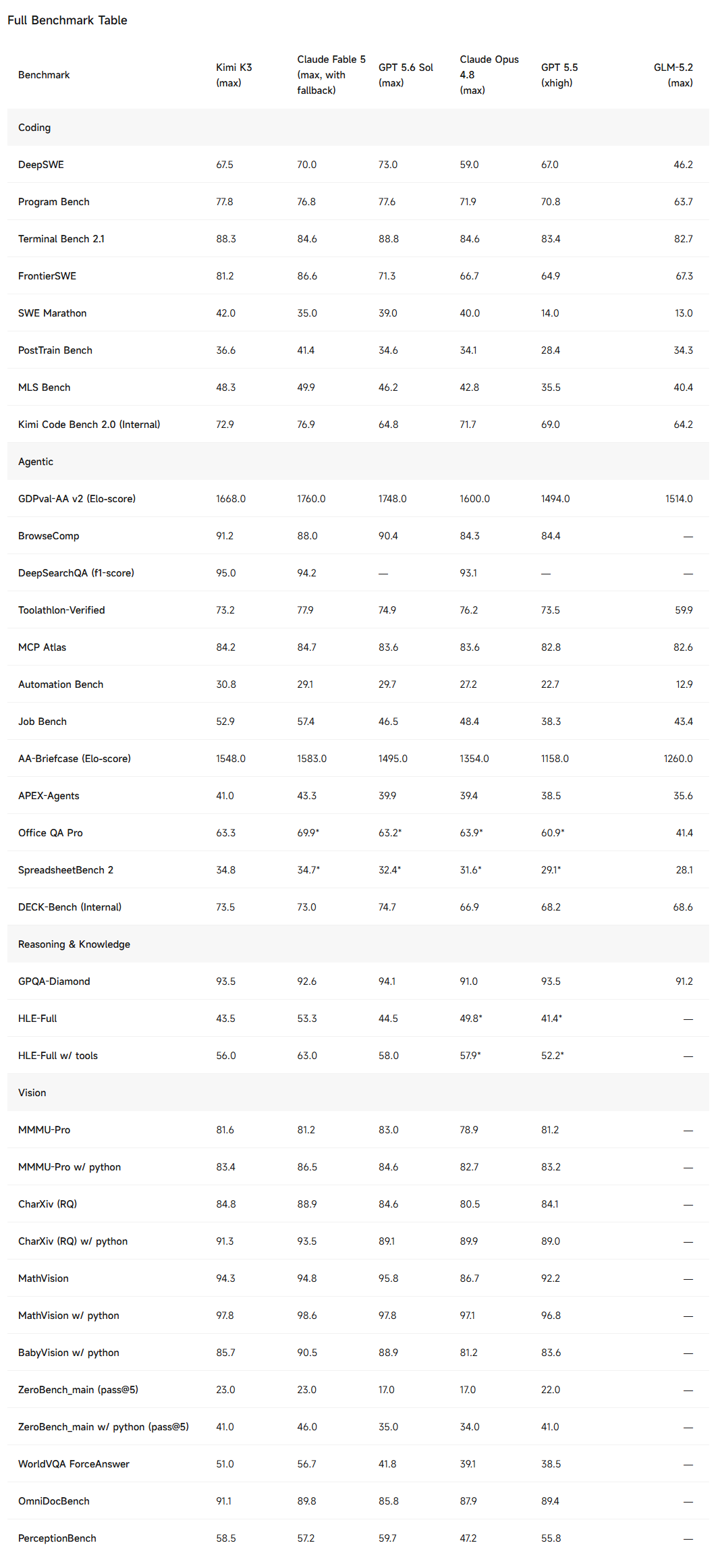
Rather than leaning solely on static leaderboard numbers, Moonshot evaluated Kimi K3 across a wide span of coding, agentic, productivity, and multimodal benchmarks — including DeepSWE, Terminal-Bench 2.1, Program Bench, SWE Marathon, FrontierSWE, PostTrain Bench, MLS Bench Lite, KCB 2.0, OfficeQA Pro, SpreadsheetBench 2, MCP Atlas, AutomationBench, BrowseComp, GDPval-AA, AA-Briefcase, and APEX-Agents — each run through one of three agentic harnesses (KimiCode, Claude Code, or Codex). On BrowseComp specifically, K3 reaches a score of 90.4 when run with its full 1-million-token context and no context-compaction applied.
Beyond the benchmark tables, Moonshot published concrete engineering case studies that illustrate real capability:
GPU kernel optimization: Given 24 hours per task to profile, rewrite, and benchmark GPU kernels across NVIDIA H200 and an alternative-vendor GPGPU, K3 performed competitively with Claude Fable 5 and clearly outperformed Claude Opus 4.8, GPT-5.6 Sol, and GPT-5.5.
Building a GPU compiler from scratch: K3 built MiniTriton, a compact Triton-style compiler with its own IR layer and PTX code generation, matching or beating Triton and torch.compile on several benchmarks.
Chip design: In a single 48-hour autonomous run, K3 designed, optimized, and verified a chip built on its own architecture, closing timing at 100 MHz within 4 mm² and sustaining over 8,700 tokens/second of simulated decode throughput.
Scientific research automation: K3 reproduced the I-Love-Q universal relations in computational astrophysics — cross-checking 20-plus papers and generating over 3,000 lines of code — in roughly two hours, a task Moonshot says would normally take a researcher one to two weeks.
Kimi K3 vs Kimi K2.7 vs Kimi K2.6
Moonshot now maintains three actively relevant model generations, and it's easy to mix them up, so here's how they actually differ.
Kimi K2.6, released April 2026, is Moonshot's prior general-purpose flagship — a large MoE model that significantly outperformed Kimi K2.5 on agentic coding and long-horizon workflows, including notable jumps on SWE-Bench Pro, Terminal-Bench 2.0, and BrowseComp. It remains the default model powering the broader Kimi chat experience for most membership tiers.
Kimi K2.7 Code, released June 2026, is a coding-specialized descendant of K2.6 rather than a general flagship replacement — a 1-trillion-parameter MoE model (roughly 32 billion active) with a 256K context window, built specifically for long-horizon software engineering. Moonshot reports around a 21.8% improvement over K2.6 on its internal Kimi Code Bench v2, alongside roughly 30% lower reasoning-token usage.
Kimi K3 sits a full tier above both: 2.8 trillion parameters versus K2.7's 1.1 trillion, a 1M-token context window versus 256K, and native multimodal input built in from the ground up. The trade-off is cost — K3 requires datacenter-class deployment to self-host, and its API output pricing sits well above K2.6 and K2.7 Code. For most coding-agent workloads today, K2.7 Code remains the more budget-friendly choice; K3 is for teams that need frontier-level reasoning, extreme long context, or multimodal understanding and are willing to pay for it.
Kimi K2.6 | Kimi K2.7 Code | Kimi K3 | |
|---|---|---|---|
Released | April 2026 | June 2026 | July 2026 |
Focus | General flagship | Coding specialist | Frontier / multimodal |
Context window | 256K | 256K | 1M tokens |
Multimodality | Limited | Vision (MoonViT) | Native, built-in |
Self-hosting | Open weights | Open weights | Weights due July 27, 2026 |
Together with the older Kimi K2 and Kimi K2 Thinking releases, this lineage is often referred to collectively as the Kimi K2 AI family — the open-weight branch that Moonshot has used to build a reputation as one of the most competitive open-source labs globally, well before K3 pushed the ceiling even higher.
Real-World Use Cases: Coding, Knowledge Work, and Beyond
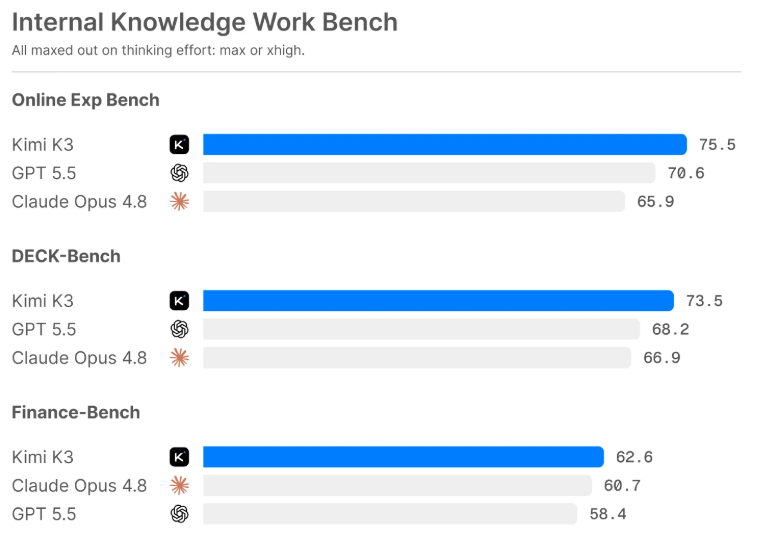
Image Credit: Kimi K3 Blog
Kimi K3's design goals center on long-horizon, minimally supervised agentic work rather than short single-turn answers. In coding, that shows up as the ability to sustain multi-hour engineering sessions, navigate large repositories, and orchestrate terminal tools with limited human intervention — including tasks that blend software engineering with visual reasoning, such as using live screenshots to refine frontend layouts, game development assets, or CAD outputs in a continuous "vision in the loop."
In knowledge work, Kimi K3 (paired with the Kimi Work desktop agent) is built around producing interactive, richly visualized deliverables rather than static text. Case studies include a 42-year interactive ASIC industry research site built through 120-plus rounds of recursive self-improvement, drawing on thousands of web searches across nearly a hundred source documents, and a gravitational-wave analysis spanning 391 events using more than 20 concurrent subagents. Kimi Work also introduces Widgets and Dashboard — interactive components that stay connected to live data, rather than freezing into a static chat response.
K3's native multimodal design extends into video and motion design too. In one demonstration, it produced a 3Blue1Brown-style animated explainer of its own architecture; in another, it edited a full teaser video from 56 raw clips — handling clip selection, motion-matched cuts, and audio processing — in what Moonshot estimates would otherwise take an experienced editor one to two full working days.
Kimi Code: Using Kimi K3 in Your Terminal
Kimi Code is Moonshot's dedicated coding-agent product — a command-line and IDE-integrated tool in the same spirit as other terminal-based coding agents. To use Kimi K3 inside Kimi Code, run the tool in your terminal and select the model with the /model command, choosing kimi-k3. Kimi Code ships with weekly refreshed usage credits tied to your membership tier, so higher plans get proportionally larger allowances and concurrency limits.
For developers building directly against the model, the path is the Kimi API Platform at platform.kimi.ai. After creating an account, generate a Kimi Code API key from the dashboard, then reference the kimi-k3 model ID using the same OpenAI-compatible request format Moonshot has supported since earlier Kimi K2 releases — making migration from existing integrations straightforward.
Kimi Plans and Membership Tiers
Kimi's consumer membership currently spans five tiers, covering the web app, mobile apps, Kimi Code credits, Agent Swarm access, and creative tools like Slides and Websites — separate from metered API billing:
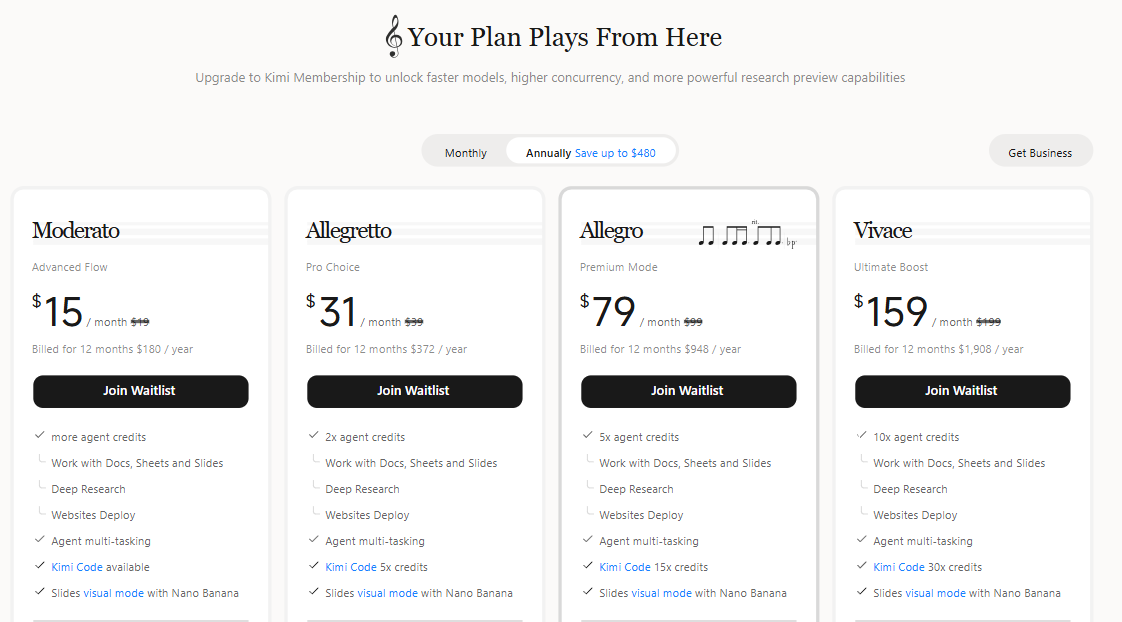
Plan | Monthly Price | Notes |
|---|---|---|
Adagio | Free | Unlimited standard chat, document upload, web browsing |
Moderato | ~$19 | Entry-level paid tier with Kimi Code credits |
Allegretto | ~$39 | Expanded agent and coding credits |
Allegro | ~$99 | Unlocks K3's extra-long chat capacity (up to 1M-token context) |
Vivace | ~$199 | Highest agent, Agent Swarm, and Kimi Code allowances |
Annual billing typically discounts each paid tier further. It's worth noting that Moonshot has flagged upcoming changes to this structure, indicating that Kimi membership and Kimi Code benefits are expected to be separated into distinct plans in a future update — existing subscribers are expected to be unaffected by the transition, but anyone budgeting for a team rollout should check the current membership page before committing to an annual plan.
Kimi Docs and Getting Started
Moonshot's developer documentation, hosted at the Kimi API Platform, covers authentication, request formatting, context caching behavior, and model-specific parameters for the full Kimi lineup — from Kimi K2 Thinking through Kimi K2.6, Kimi K2.7 Code, and now Kimi K3. Because the API follows an OpenAI-compatible schema, most existing SDKs and tooling built for other providers can be pointed at Moonshot's endpoint with minimal changes, typically just swapping the base URL and API key. For self-hosting once weights are available, Moonshot's documentation and community contributions cover deployment through vLLM, SGLang, and similar inference frameworks, including the KDA-compatible prefix-caching support contributed specifically for Kimi K3.
Limitations to Know Before You Deploy
Moonshot has been unusually candid about where Kimi K3 still falls short. The model is sensitive to thinking history — it expects its full reasoning trace passed back across turns, so switching an in-progress session from another model to K3, or using a harness that doesn't preserve thinking content, can produce unstable output; Moonshot recommends a verified-compatible harness such as Kimi Code. K3 also tends toward excessive proactiveness: when it hits minor ambiguity on long tasks, it may make judgment calls on the user's behalf rather than pausing to ask, so applications needing strict boundaries should add explicit constraints via the system prompt or an AGENTS.md file. Finally, Moonshot acknowledges a noticeable user-experience gap versus Claude Fable 5 and GPT-5.6 Sol in day-to-day use, despite K3's strong benchmark and case-study results.
Final Thoughts
Kimi K3 marks a significant escalation in Moonshot AI's open-weight strategy — not just a bigger model, but a structurally different one, built around new attention mechanisms and an aggressively sparse expert design that make trillion-scale reasoning economically viable through the Kimi API. Whether it's the right choice for your workflow depends on what you're optimizing for: if you need the absolute highest-fidelity model available today, the top proprietary options still edge it out by Moonshot's own admission. But for teams that want frontier-adjacent coding and agentic performance, a genuinely enormous context window, and a licensing path toward self-hosting — all at a fraction of typical frontier pricing — Kimi K3 is now one of the most serious options on the table.
FAQs
What is Kimi K3?
Kimi K3 is Moonshot AI's flagship large language model, released July 16, 2026. It's a 2.8-trillion-parameter, open-weight model built on new Kimi Delta Attention and Attention Residuals architecture, with native multimodality and a 1-million-token context window, aimed at long-horizon coding, knowledge work, and reasoning tasks.
Who is behind Kimi?
Kimi is developed by Moonshot AI, a Beijing-based startup founded in March 2023 by Yang Zhilin, Zhou Xinyu, and Wu Yuxin. CEO Yang Zhilin, a Carnegie Mellon PhD and former Google Brain and Meta researcher, co-authored influential architecture papers including Transformer-XL and XLNet before returning to China to start the company, which is named after Pink Floyd's The Dark Side of the Moon.
Can I use Kimi K3 for free?
Yes, to an extent. Kimi's free Adagio tier gives access to standard chat, document uploads, and web browsing, but Kimi K3's extra-long 1M-token chat capacity and higher-volume agent features are reserved for paid membership tiers starting around $19 per month, and full API access is billed separately per token.
How good is Kimi K3?
Kimi K3 delivers frontier-level results across Moonshot's coding, agentic, and multimodal evaluation suites, and has produced notable real-world demonstrations — from building a working GPU compiler to designing a functioning chip autonomously. Moonshot itself states the model still trails the very top proprietary systems, Claude Fable 5 and GPT-5.6 Sol, in overall performance, but leads consistently among the other models it was tested against.
Is Kimi better than ChatGPT?
It depends on the task and the trade-off you care about. Kimi K3 offers a larger context window, open-weight availability, and notably lower API pricing than most comparable proprietary models, making it attractive for cost-sensitive, high-volume, or self-hosted use cases. However, Moonshot's own published limitations acknowledge a user-experience gap against the newest GPT models in everyday use, so teams prioritizing polish and consistency over raw cost efficiency may still prefer ChatGPT for certain workflows.