
OpenAI has introduced Prism as its latest product within its growing collection of generative AI tools which provides users with a free AI-powered workspace that boosts their scientific writing and research work and team collaboration. Prism is a cloud-based environment that combines writing and editing functions with citation management, team collaboration, and literature searching capabilities through its LaTeX-native system powered by GPT-5.2’s advanced reasoning capabilities. Researchers and scientists now possess a complete new method to manage their intricate research processes which used to require them to use various software solutions.
This article presents a comprehensive, up-to-date review of the features of Prism, its benefits, implications for the scientific community, main uses and limitations, and its compatibility with new trends on artificial intelligence in research.
What Is OpenAI Prism? A Clear Definition
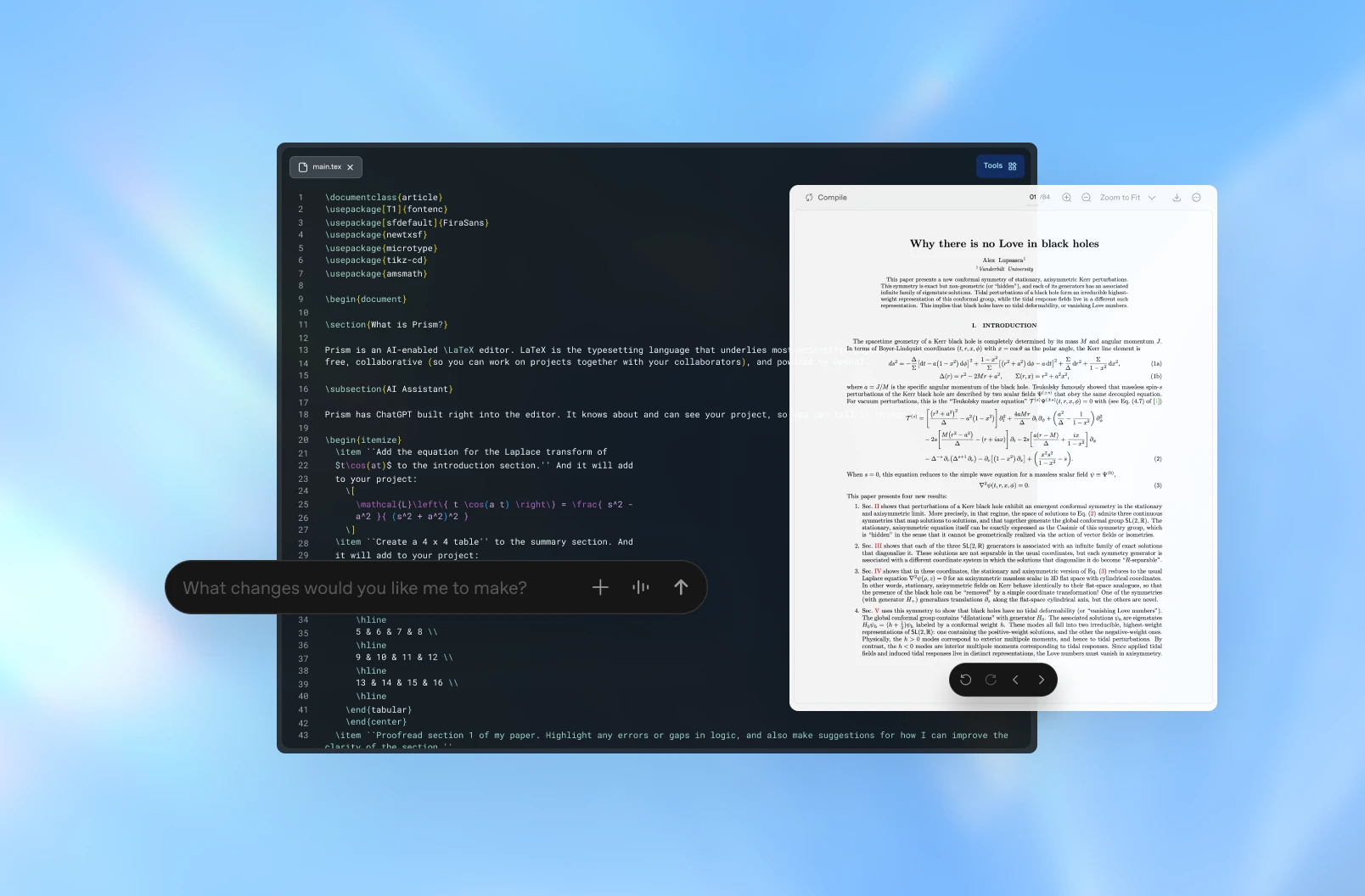
Image Source: OpenAI
Prism is a free, AI-powered workspace introduced by OpenAI that enables scientific researchers, academics, and technical writers to write, edit, reason about, and collaborate on research papers and scientific documents within a unified platform. It integrates OpenAI’s GPT-5.2 model directly into the authoring and reasoning process, unlike traditional tools that leave AI in a separate chat window or force users to juggle multiple disconnected applications.
Key attributes of Prism include:
- LaTeX-Native Interface: Designed around LaTeX workflows, catering to the standard format used in scientific and technical publishing.
- AI Reasoning Context: GPT-5.2 accesses the full document context — including equations, figures, citations, and text structure — to provide more accurate and relevant suggestions.
- Cloud-Based Collaboration: Unlimited collaborators and projects hosted in the cloud, enabling real-time co-editing and version consistency.
- AI-Assisted Drafting and Revision: Helps with drafting text, revising existing content, and adjusting scientific prose while maintaining concept continuity.
Prism aims to reduce the friction inherent in scientific workflows where researchers frequently switch between text editors, code environments, PDF readers, LaTeX compilers, citation managers, and standalone AI chats — often losing context and productivity in the process.
Why Prism Matters: The Case for Integrated AI in Science
Addressing Fragmented Research Workflows
Traditional scientific writing demands moving between multiple applications: document editors, LaTeX compilers, citation databases, PDF viewers, statistical tools, and discussion platforms. This fragmentation interrupts cognitive flow and increases manual overhead. Prism’s unified workspace ensures context is preserved across drafting, citing, reasoning, and collaboration.
Enhancing Research Productivity
Researchers often spend more time formatting documents, merging edits, and managing references than on conceptual thinking. Prism’s AI can:
- Draft and revise text with full-document context dependence.
- Integrate equations, figures, and citations seamlessly.
- Pull in relevant literature and help ensure references are properly supported.
- Convert diagrams or handwritten sketches into LaTeX.
This reduces manual grunt work and gives researchers greater capacity to focus on analysis, creativity, and hypothesis testing.
Lowering Barriers to Scientific Collaboration
Prism offers unlimited collaborators without seat limits or subscription fees for personal ChatGPT accounts, broadening access to high-value tools that were traditionally gated behind costly software licenses.
Core Capabilities and Features of Prism
AI-Integrated Scientific Drafting
Unlike a standalone AI chat that responds to isolated prompts, Prism’s GPT-5.2 model works directly within the live document context. It can generate coherent text that aligns with existing structure, meaning suggestions respect tone, layout, and formatting requirements particular to scientific writing. This is critical when drafting complex sections like methodologies, results descriptions, or theoretical discussions.
Reasoning Across Document Context
Prism’s advanced reasoning extends beyond simple language generation. Because GPT-5.2 can process mathematical expressions, references, and logical flows across sections, it supports researchers in testing hypotheses, refining arguments, and checking internal consistency. This is especially useful for disciplines where logical coherence and evidence chains are central.
Citation Management and Literature Integration
One of Prism’s standout capabilities is its ability to search, identify, and integrate relevant literature seamlessly. Instead of manually searching external databases then switching back to a LaTeX editor, researchers can interact with literature contextually, ensuring citations are correctly placed and aligned with current argumentation.
Real-Time Collaboration
Prism supports simultaneous editing by multiple collaborators in real time, eliminating version conflicts and simplifying co-authorship. Unlimited collaborators and projects mean teams can scale without technical barriers.
LaTeX-Native Support
Prism’s LaTeX compatibility is not superficial: it embeds the LaTeX environment into the workflow so that equations, figures, bibliographies, and formatting commands remain central to document structure — while also benefiting from AI-augmented drafting.
Diagram and Equation Integration
AI can convert hand-drawn sketches or whiteboard images into LaTeX equations or diagrams ready for insertion into manuscripts, reducing time and errors in transcription.
Voice-Assisted Editing
Some interfaces include optional voice-based edits, enabling users to dictate changes or new sections when manual typing is inconvenient.
Prism in Action: Real-World Use Cases
Academic Research Teams
Large research groups juggling multi-section manuscripts — with contributors scattered across institutions — benefit from Prism’s real-time collaboration, automatic citation integration, and AI-assisted revisions. This can accelerate journal submission and reduce cycles of rework.
Graduate Students and Early Career Researchers
For students unfamiliar with sophisticated LaTeX environments or complex citation formats, Prism provides guided support that reduces technical learning barriers. AI assistance can help parse difficult sections of writing or format according to journal standards.
Cross-Disciplinary Projects
Projects that span mathematics, biology, engineering, and data science often involve complex notation, statistical reporting, and structured reasoning. Prism’s context-aware AI can help ensure clarity and logical integrity across sections and domains.
Collaborative Grant Writing
Grant proposals require coherence, clarity, and alignment with funding goals. Prism’s AI can assist in tailoring proposals to specific themes, criteria, and reviewer expectations, reducing administrative friction.
Benefits Over Traditional Tools
| Feature | Traditional LaTeX Editors + Tools | OpenAI Prism |
| Integrated AI reasoning | No | Yes (GPT-5.2) |
| Unified writing and citation | No | Yes |
| Real-time collaboration | Limited | Full, with unlimited collaborators |
| AI-assisted literature search | Separate tools required | Built-in |
| Equation & diagram AI generation | Manual | AI-assisted |
| Context-aware drafting & revision | Partial | Deep integration |
| Voice editing | Rare | Supported |
Limitations and Considerations
Not a Replacement for Scientific Discovery
Prism is a workspace and assistant, not an autonomous research agent. While it can accelerate drafting and reasoning, critical judgment and domain expertise remain essential.
Contextual Accuracy Still Human-Verified
Although GPT-5.2 integrates document context, users must verify factual, methodological, and ethical elements of their work. AI can assist but should not replace peer review or expert validation.
Early Access and Organizational Rollout
Prism is currently available for free to users with personal ChatGPT accounts. Broader access for organizations on ChatGPT Business, Team, Enterprise, and Education plans is coming soon.
Industry Trends and Impacts
Shifting Research Workflows
AI increasingly supports scientific workflows — from data analysis to literature reviews. Prism reflects this trend by collapsing multiple disparate tools into one platform, aligning with other research AI movements such as integrated code execution for simulations or reasoning over large datasets.
AI Collaboration, Not Replacement
AI’s role in science is augmentative. Tools like Prism demonstrate how AI can handle mechanical and logistical tasks, allowing humans to focus on theory, experimentation, and innovation.
Democratization of Scientific Tools
Prism’s free availability democratizes access to high-end research infrastructure, potentially reducing inequality in research capability across institutions and regions.
Conclusion
OpenAI Prism is an advanced research tool that transforms the structure and operation of scientific research workflows. The system enables researchers to work on their core academic tasks because it links AI with all aspects of their LaTeX workspace, including drafting, collaboration, citation management and reasoning. Its free availability democratizes access to advanced research infrastructure, which corresponds with wider developments in AI-based research tools and productivity software. As the academic and scientific communities implement responsible AI, they will use Prism as their first step toward developing a research ecosystem that works better through enhanced connectivity and AI support.
FAQs
What is OpenAI Prism?
Prism is a free, AI-native cloud workspace designed for scientific writing and collaboration, integrating GPT-5.2 for contextual drafting, collaboration, equations, and literature management.
Who can use Prism today?
Anyone with a ChatGPT personal account can use Prism immediately, with broader organizational access planned for business and educational plans.
Does Prism replace LaTeX editors?
Prism builds on LaTeX workflows rather than replacing them, providing AI-assisted drafting and collaboration inside a LaTeX-native workspace.
Can Prism search and integrate academic literature?
Yes, Prism allows contextual literature search and citation integration directly within manuscripts.
Does Prism require coding skills?
No. While LaTeX knowledge helps, Prism’s interface and AI assistance reduce the need for deep technical expertise.
Can multiple collaborators work simultaneously?
Yes. Prism supports real-time collaboration with unlimited collaborators and projects.
Can Prism convert sketches to LaTeX?
Prism includes AI tools that can convert diagrams and whiteboard sketches into LaTeX code.
Is Prism free?
Yes — for users with a ChatGPT personal account. Business and enterprise access is coming soon.
Does Prism conduct research autonomously?
No. Prism assists researchers but does not independently perform scientific discovery.
Is Prism available internationally?
Yes, Prism is available online via the web and doesn’t require local software installations.