
Anyone searching for an SEO agency in Germany runs into the same wall almost immediately: nobody publishes a real price. Ask five agencies what SEO costs and you'll get five different answers, because the honest answer is "it depends" — on your industry, your website's technical condition, how competitive your keywords are, and increasingly, whether you also need visibility inside AI answers like ChatGPT and Google's AI Overviews.
That uncertainty is exactly why this guide exists. Below you'll find real 2026 pricing across every common billing model — hourly, project-based, and monthly retainer — broken down by service type, by city, and by industry, along with the hidden costs most first-time buyers never see coming. At the end, you'll also find a free interactive cost calculator so you can estimate your own SEO budget in under a minute.
Quick answer: Most SEO in Germany is billed as a monthly retainer between €800 and €6,000 for small and mid-size businesses, and €6,000 to €30,000+ for enterprise programs. One-off technical audits typically cost €1,500 to €18,000, and hourly consulting runs €40 to €270 depending on seniority and city. A realistic working floor for a program expected to move the needle in a competitive niche sits closer to €1,800/month — budgets under €800 are almost always single-service, single-location work, not a full SEO program.
1. Average SEO Cost in Germany in 2026 by Pricing Model
SEO agencies and freelancers in Germany typically bill in one of three ways, and the model you choose changes both the total cost and what you actually get — not just the number on the invoice.
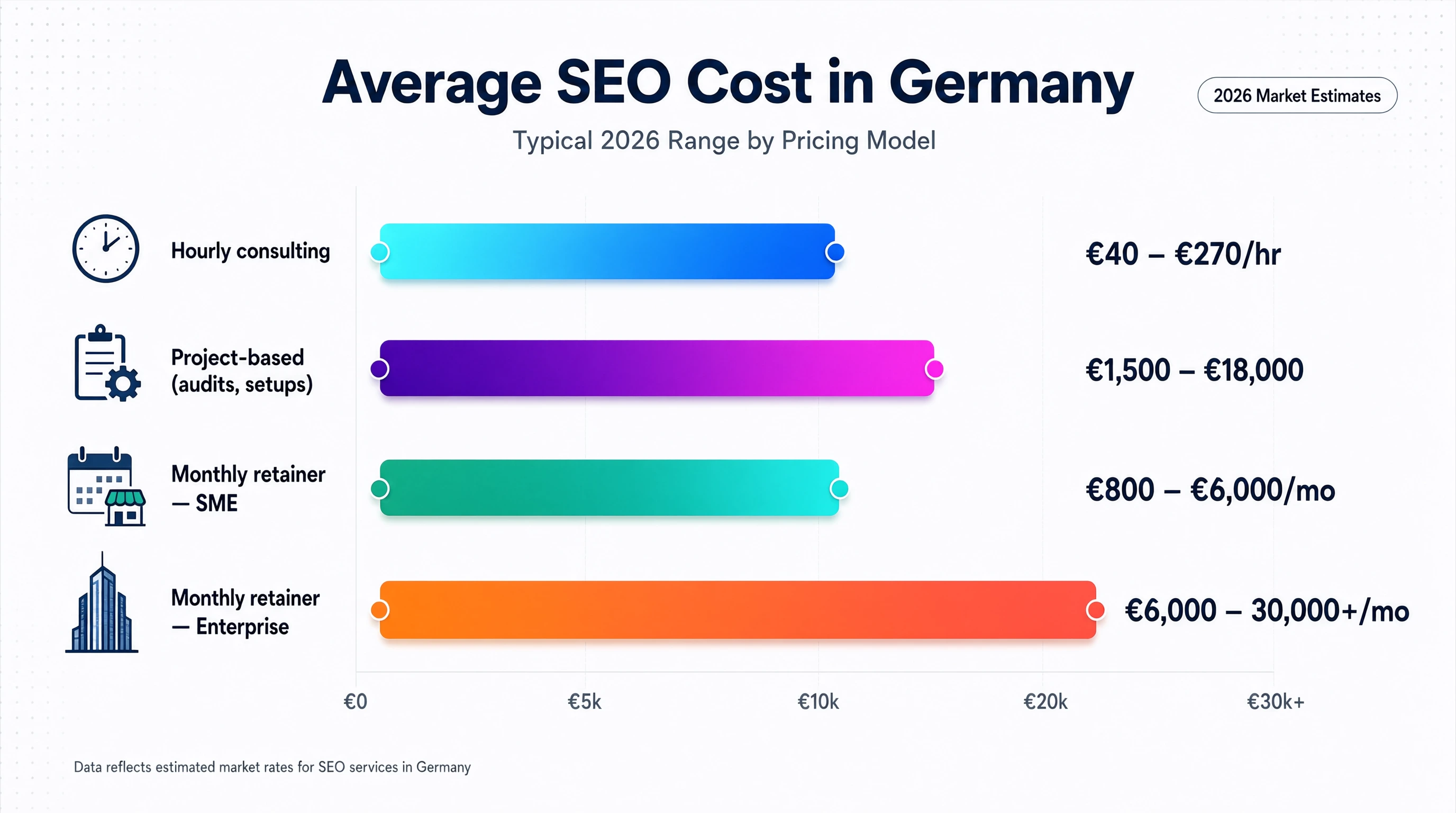
Pricing Model | Typical 2026 Range | Pros | Cons | Best For |
Hourly consulting | €40 – €270/hr | Full transparency, no long-term commitment | Hard to sustain a coherent strategy in isolated hours | Ad-hoc advice, targeted fixes, second opinions |
Project-based (audits, setups) | €1,500 – €18,000 | Clear scope and deliverable; low-risk way to test a provider | One-time only — no ongoing optimization | Technical audits, relaunch support, one-time setups |
Monthly retainer — SME | €800 – €6,000/mo | Continuous, compounding growth | Needs a 6+ month commitment before ROI is visible | Ongoing growth for small and mid-size businesses |
Monthly retainer — Enterprise | €6,000 – €30,000+/mo | Dedicated team, full technical + content + GEO coverage | Higher management overhead, longer onboarding | Multi-market, high-competition, large domains |
Hourly Consulting
Hourly rates offer the most transparency but the least strategic depth, and the rate itself varies enormously by experience level. Budget consultants and generalist freelancers typically bill €40–€90/hr; mid-level specialists with a proven track record in one discipline (technical SEO, content, or link building) sit around €90–€150/hr; senior strategists and technical leads capable of running a full program command €150–€270/hr — consistent with German agency-side reporting that puts the national average hourly rate at €90–€200, and with DACH-wide research showing senior specialists at premium agencies reaching €180–€300/hr. Occasionally you'll see hourly rates advertised as low as €15–€35 by very small regional providers — treat these with caution, since they usually reflect generalist web freelancers rather than dedicated SEO specialists. Hourly billing works well for a single audit call or a specific technical fix, but SEO results compound over months, so isolated hours rarely add up to a coherent strategy.
Project-Based Pricing
Project pricing suits one-time deliverables: a comprehensive technical audit, a website relaunch migration, or an initial keyword and content strategy. A thorough audit for a mid-size to large site typically falls between €1,500 and €18,000 depending on how many pages, markets, and technical issues need to be reviewed. Below that range, expect a surface-level checklist rather than a genuine audit.
Monthly Retainers
The retainer model is the industry standard for continuous SEO work, because meaningful ranking improvements take months to materialize and require ongoing technical, content, and link-building effort. SME budgets typically start around €800–€1,800 per month for a focused, single-market program and scale to €6,000 for more competitive niches; agencies that specialize in harder verticals often set their realistic entry point closer to €1,800. Enterprise programs — multi-market, high-competition, or requiring dedicated data infrastructure — commonly run €6,000 to €30,000 or more per month. A large-scale anonymized survey of 521 German SEO agencies found that for most clients, the monthly retainer sits between €500 and €3,000, with hourly rates between €90 and €200 — figures broadly consistent with other German-market pricing research placing typical DACH retainers between €500 and €10,000 per month. Globally, Ahrefs' 2026 survey of 439 SEO providers puts the average agency retainer at $3,209/month (roughly €3,000) — a useful reference point, but one that blends single-location local SEO with far more demanding multi-channel programs, so treat it as a baseline rather than a target for your own budget.
Watch out for minimum packages under €500 a month or flat rates with no reporting attached — see Section 11 for how to spot an offer that's too good to be true.
SEO Cost by Service Type
"SEO" bundles together several distinct disciplines, and each carries its own cost profile.
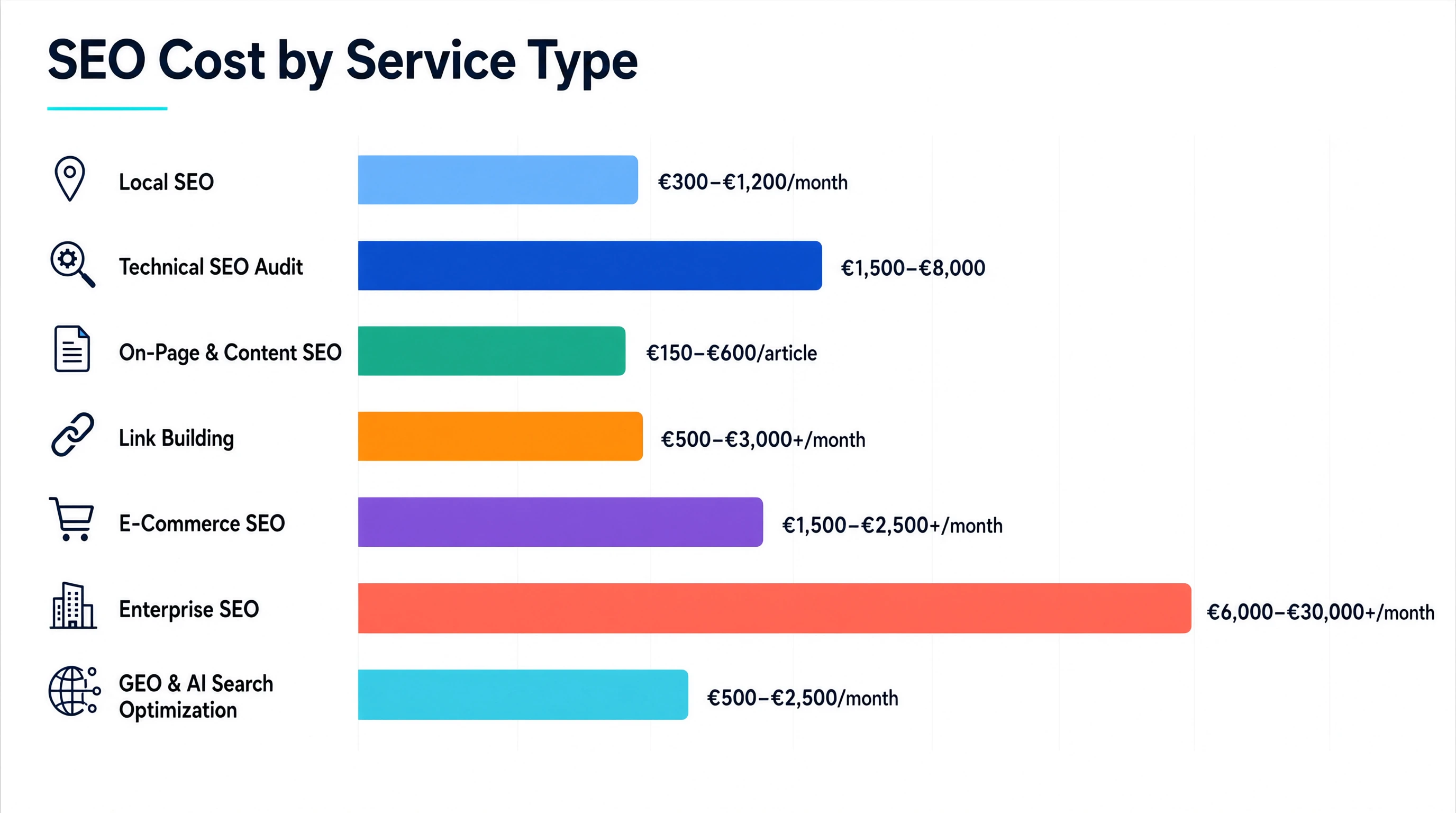
Local SEO — Google Business Profile optimization, local citations, and location-specific landing pages — is the most affordable entry point, typically €300–€1,200 per month for a single-location business. Multi-location businesses scale up per additional location.
Technical SEO Audit — examines crawlability, indexing, site speed, structured data, and architecture. Expect €1,500–€8,000 for a small-to-mid site, rising toward €18,000+ for large, complex domains with international sections or heavy e-commerce catalogs.
On-Page and Content SEO — keyword-mapped landing pages, blog content, and topic clusters — is usually priced per piece (€150–€600 per article depending on depth and expertise required) or folded into a monthly retainer covering a fixed content volume.
Link Building — one of the most variable cost centers in SEO, because link acquisition depends on outreach effort and the authority of the sites involved. Expect €500–€3,000+ per month as part of a broader retainer, with highly competitive niches (finance, legal, SaaS) at the top of that range.
E-Commerce SEO — adds product page optimization at scale, category architecture, and technical work around faceted navigation and duplicate content. Retainers for e-commerce sites commonly start at €1,500–€2,500 per month and scale with catalog size.
Enterprise SEO — shifts focus from individual keywords to topic clusters, cross-department coordination between IT, marketing, and PR, and dedicated tracking infrastructure to manage risk across large domains. This coordination overhead is one of the main reasons enterprise retainers (Section 1) sit so far above SME pricing — you're not just buying more hours, you're buying a data and reporting layer that a smaller program doesn't need.
GEO and AI Search Optimization — optimizing for generative answers — being cited inside ChatGPT, Perplexity, and Google's AI Overviews — has become a distinct line item in 2026 proposals. Agencies typically price this as an add-on to a retainer, commonly €500–€2,500 per month, covering structured data preparation, answer-focused content formatting, and AI citation tracking.
SEO Cost by City in Germany
As with software development, SEO rates shift by city because senior talent concentrates around specific hubs and client industries differ from region to region.
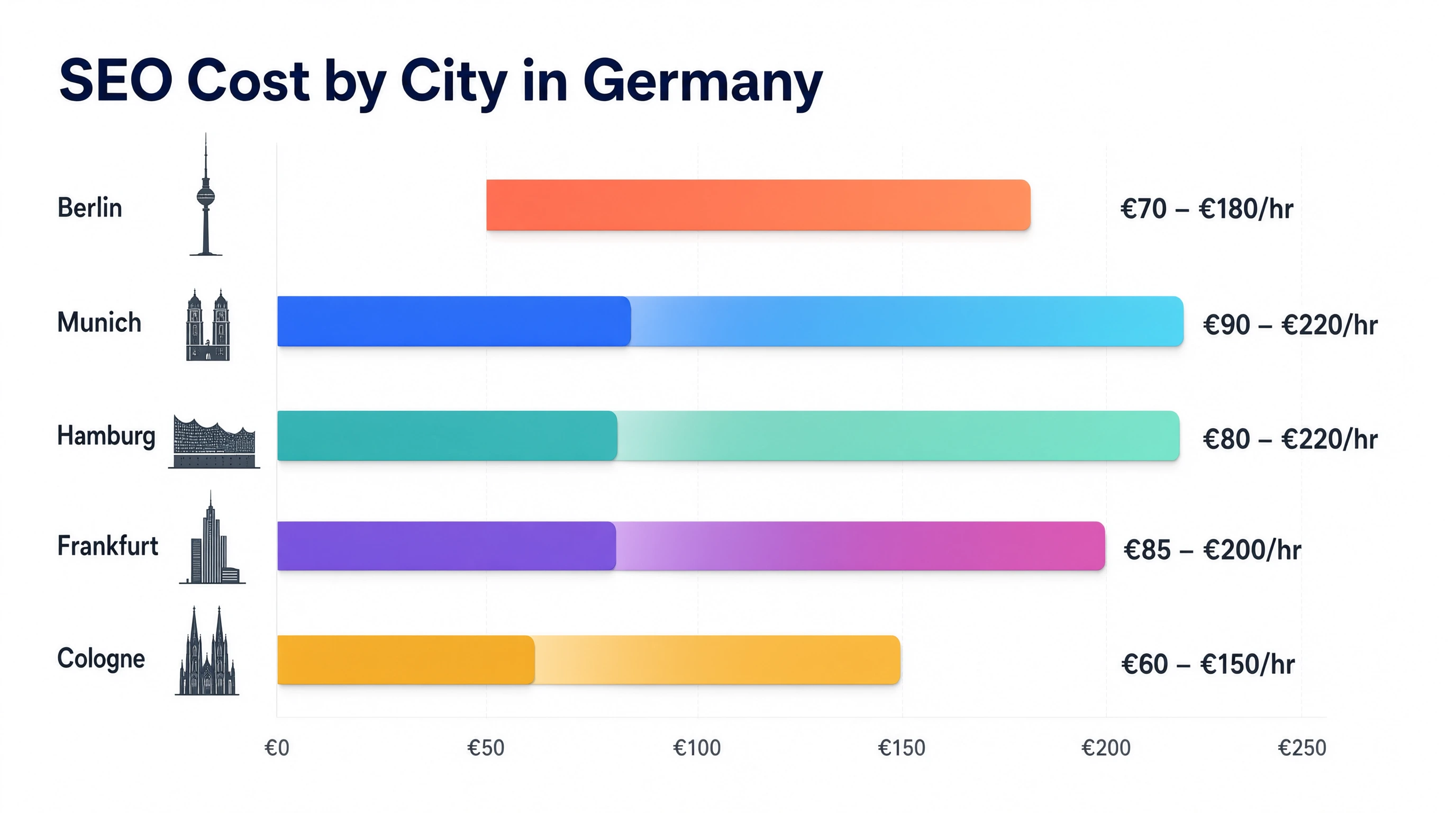
City | Typical Hourly Rate | Market Character |
Berlin | €70 – €180/hr | Startup and SaaS-heavy, wide range of agency sizes |
Munich | €90 – €220/hr | Enterprise, automotive, and finance clients |
Hamburg | €80 – €220/hr | Media and e-commerce; consistently among the priciest hubs |
Frankfurt | €85 – €200/hr | Banking and finance-driven compliance-heavy work |
Cologne | €60 – €150/hr | Value-friendly hub for mid-size and regional businesses |
Outside these five hubs, rates in smaller cities and towns can run meaningfully lower — sometimes by half or more — reflecting both lower cost of living and less competition among local providers for the same senior talent. Regional data bears this out: some of the country's lowest published hourly rates sit well under €60, while some of the highest cluster in Hamburg. As with software development, the discount comes with a trade-off: smaller local markets often have a thinner bench of specialists in technical SEO or GEO.
What Affects SEO Pricing in Germany?
Two businesses in the same industry can pay wildly different SEO retainers. These are the variables that actually move the number.
1. Competitive Intensity
Finance, insurance, legal, and SaaS niches require significantly more resources to outrank entrenched competitors than low-competition local markets.
2. Technical Condition
An outdated site with major crawling and indexing issues requires substantial upfront technical work before content or links can have any effect. Without a solid technical foundation, even the best content stays invisible to search engines.
3. Content Needs and E-E-A-T
Producing content that satisfies both users and AI-powered search systems takes more expert time than templated blog posts, especially in regulated or technical industries.
4. Internationalization
Ranking across multiple languages and countries multiplies the work needed for hreflang management, localization, and market-specific digital PR.
5. AI Visibility (GEO/LLMO)
Being cited as a source inside AI-generated answers requires dedicated data structuring and content formatting work layered on top of traditional SEO — and it's rapidly becoming a line item every proposal needs, not an optional extra.
6. Industry Vertical
Regulatory scrutiny and keyword competition both shift heavily by sector — see Section 6 for how cost floors move by industry.
7. Business Size and Domain Complexity
Larger domains with more pages, products, and stakeholders require more coordination and tracking infrastructure, which shows up directly in retainer pricing.
SEO Cost by Industry
Industry shapes SEO cost as much as company size does, largely because of how competitive the keyword landscape is and how much compliance sits on top of the content.
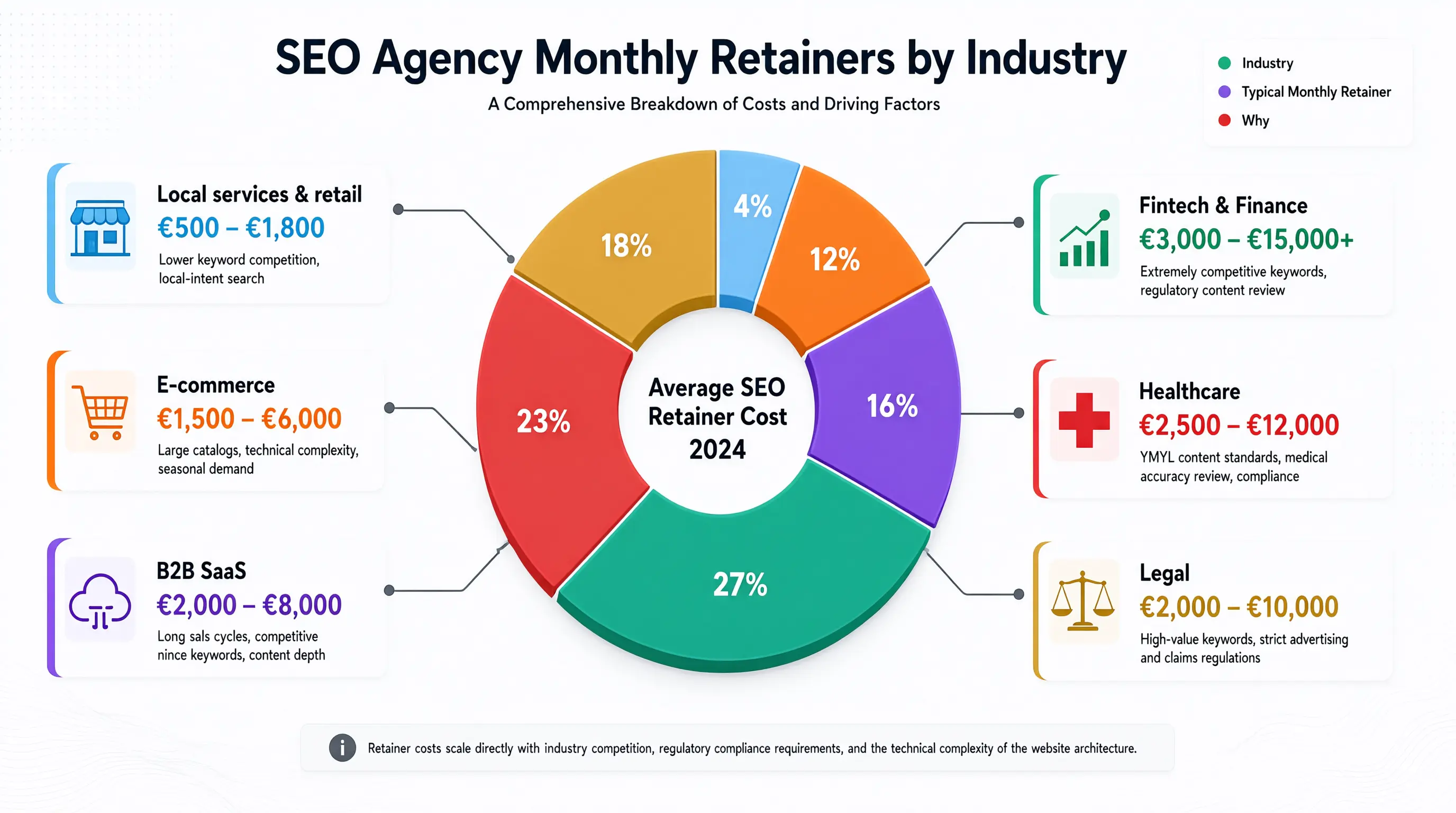
Industry | Typical Monthly Retainer | Why |
Local services & retail | €500 – €1,800 | Lower keyword competition, local-intent search |
E-commerce | €1,500 – €6,000 | Large catalogs, technical complexity, seasonal demand |
B2B SaaS | €2,000 – €8,000 | Long sales cycles, competitive niche keywords, content depth |
Fintech & Finance | €3,000 – €15,000+ | Extremely competitive keywords, regulatory content review |
Healthcare | €2,500 – €12,000 | YMYL content standards, medical accuracy review, compliance |
Legal | €2,000 – €10,000 | High-value keywords, strict advertising and claims regulations |
Finance and healthcare sit at the top of this table for the same underlying reason: Google treats both as "Your Money or Your Life" (YMYL) categories, which means content faces stricter accuracy and expertise scrutiny — and agencies price in the additional review and compliance work that requires.
SEO vs. Paid Search: Using Your Budget Strategically Across Channels
Most businesses plan organic and paid search as two separate line items answering to two separate KPIs. That's a missed opportunity, and it's one of the fastest-growing conversations in 2026 budget planning.
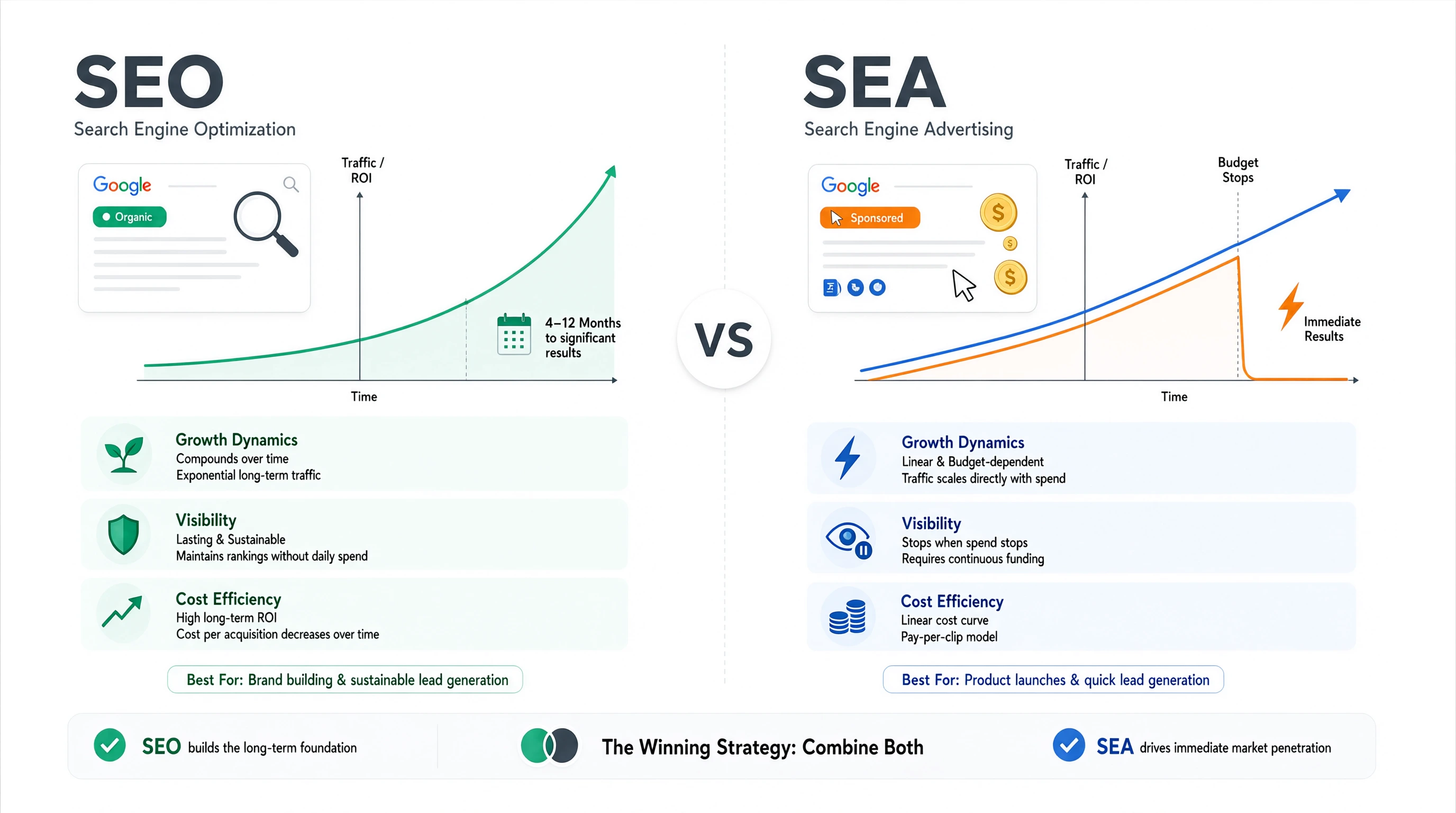
SEO | Paid Search (SEA) | |
Time to results | 4–12 months | Immediate |
Cost curve | Front-loaded, then compounds | Linear — stops the moment spend stops |
Durability | Builds a lasting asset | Disappears when the budget is cut |
Best for | Sustainable, high-intent visibility | Testing, seasonal demand, immediate coverage |
Paid search data tells you which keywords actually convert — that's information most businesses already have and rarely use for SEO planning. Feeding it back in lets you direct organic budget toward commercially proven terms instead of guessing at traffic volume. The relationship runs the other way too: once a keyword ranks organically, the paid spend on that same term can often be reduced or redirected elsewhere, gradually lowering blended customer acquisition cost.
This isn't an argument for choosing one channel over the other. It's a case for sequencing spend so each channel does the job it's actually good at — paid search for immediate visibility and fast testing, organic for the compounding presence that keeps working long after a campaign budget runs out. A strong organic foundation and growing AI visibility also reduce long-term dependence on ever-rising cost-per-click, which is worth factoring into any multi-year marketing budget.
2026 Compliance Costs Affecting SEO in Germany
Two regulatory areas increasingly show up as line items in German SEO proposals, and neither is covered in most competing guides.
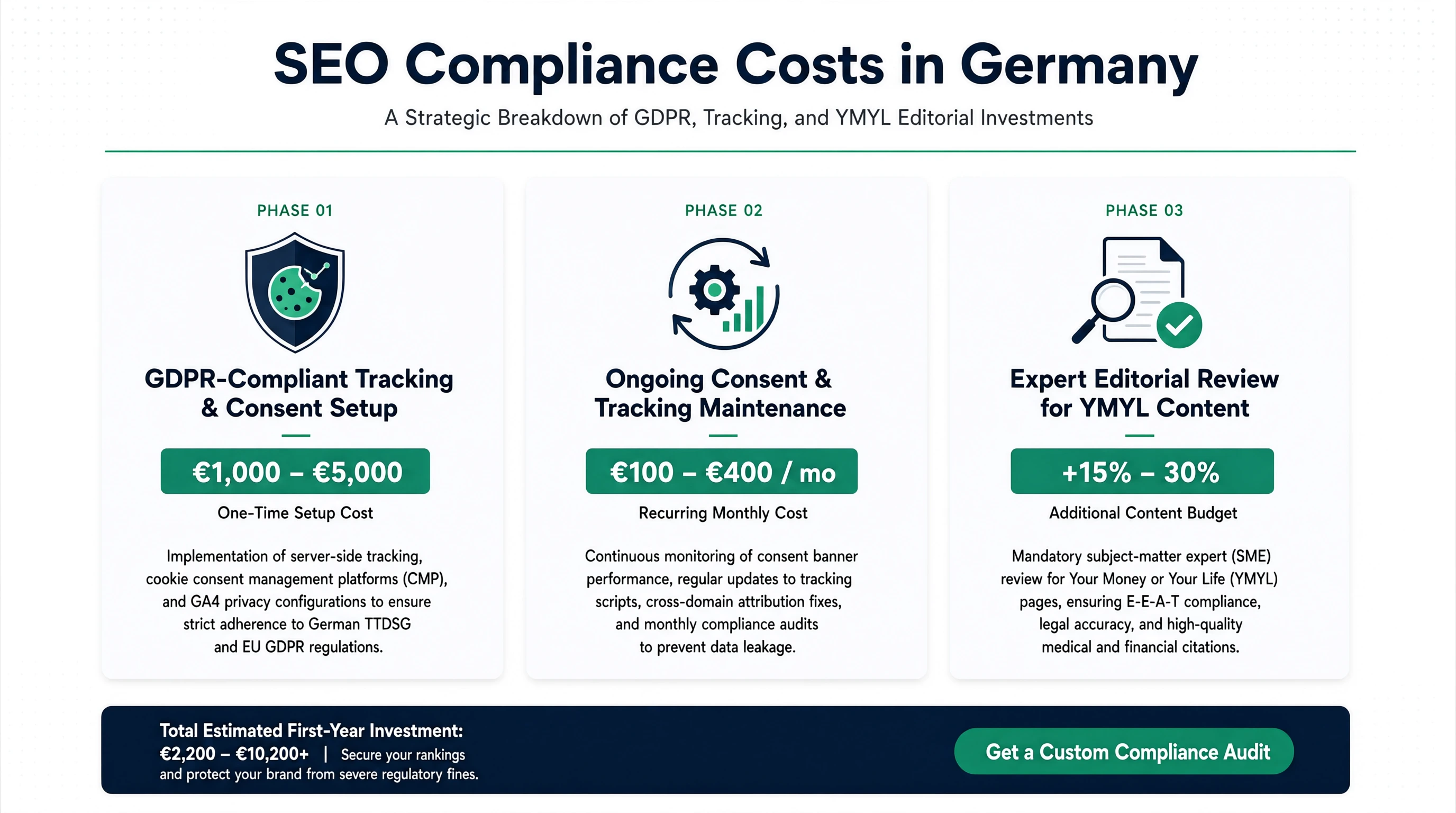
GDPR-Compliant Tracking and Analytics — Measuring SEO performance requires analytics and tag management, and doing this in a GDPR-compliant way — consent management platforms, IP anonymization, and increasingly server-side or cookieless tracking setups — adds both one-time setup cost and ongoing maintenance. Budget roughly €1,000–€5,000 for initial compliant tracking setup, depending on how many tools and data flows are involved.
AI Content Transparency — As AI-assisted content production becomes standard practice, businesses are increasingly building internal review and disclosure processes to manage accuracy and liability risk around AI-generated content — particularly in YMYL categories like finance and healthcare where content accuracy carries higher stakes. This isn't a fixed line item yet the way GDPR compliance is, but agencies serving regulated industries increasingly build editorial review time into their content costs to manage this risk.
Compliance Area | Estimated Added Cost |
GDPR-compliant tracking & consent setup | €1,000 – €5,000 one-time |
Ongoing consent/tracking maintenance | €100 – €400/month |
Expert editorial review for YMYL content | +15% – 30% of content budget |
As with software development, who does the work changes the total cost more than almost any other decision.
Freelancer vs. Agency vs. In-House SEO Costs
As with software development, who does the work changes the total cost more than almost any other decision.
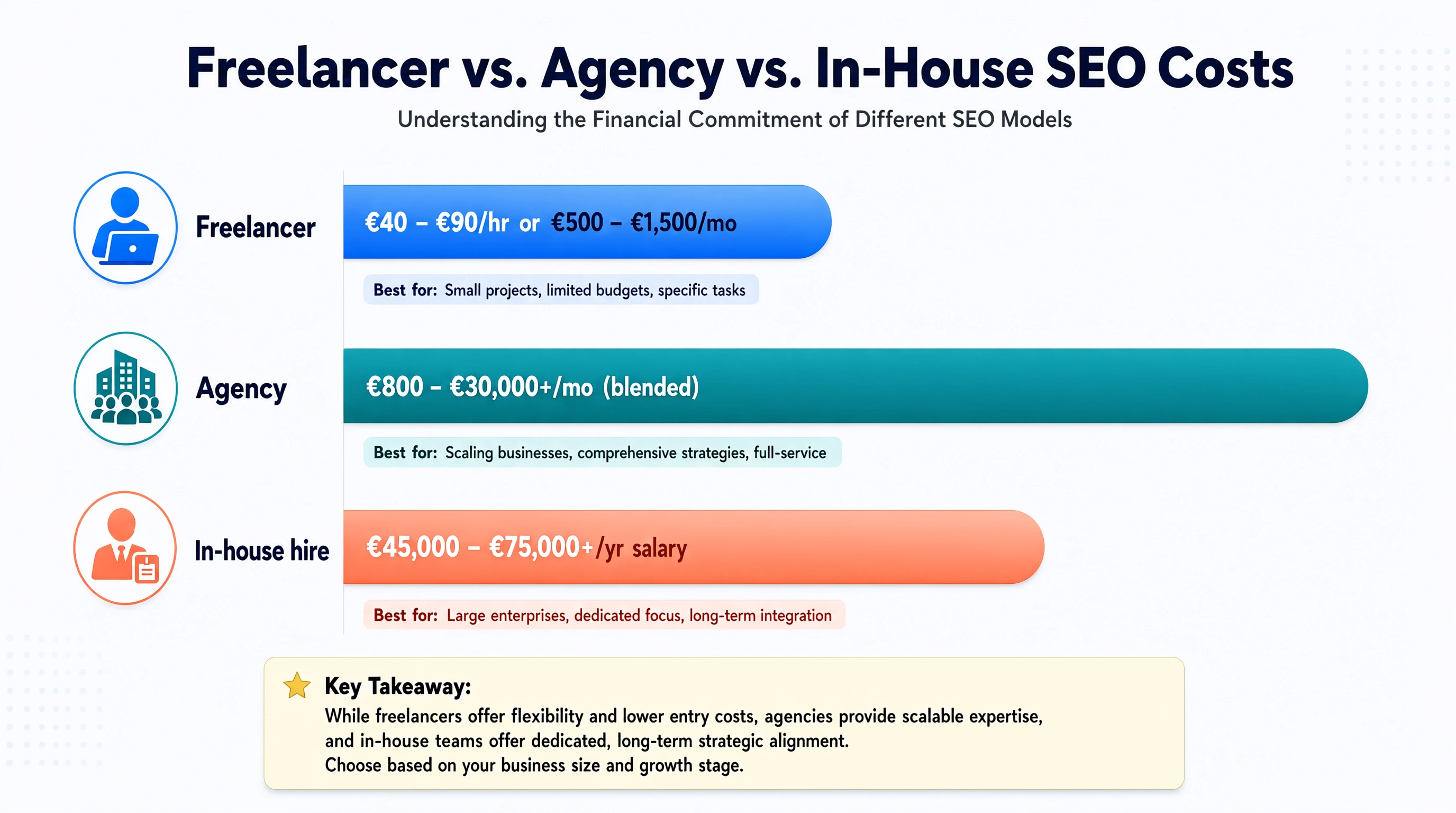
Model | Typical Cost | Best For | Watch Out For |
Freelancer | €40 – €90/hr or €500 – €1,500/mo | Small businesses, single-service needs | Limited bandwidth for technical + content + links together |
Agency | €800 – €30,000+/mo blended | Businesses needing full-service, ongoing strategy | Fit between agency specialism and your industry |
In-house hire | €45,000 – €75,000+/yr salary | Companies treating SEO as core, long-term infrastructure | 6+ month ramp-up; one person rarely covers technical, content, and outreach equally well |
Freelancers are the cheapest entry point but rarely cover technical SEO, content strategy, and link building equally well — most freelancers specialize in one or two of the three. Agencies bundle these disciplines together along with reporting and account management, which is why blended agency rates look higher than a freelancer's hourly rate but often deliver more complete coverage. In-house hires make sense once SEO is core to the business model and needs someone embedded in product and content decisions daily — but a single in-house hire still often needs external specialist support for technical audits or large-scale link building.
Hidden Costs Most Businesses Ignore
The retainer or project quote is rarely the full cost of running SEO. Splitting these into what bills every month versus what lands in a lump sum makes them much easier to budget for.
Recurring Costs
SEO tools — enterprise-grade platforms like Ahrefs, Semrush, or Sistrix cost €100–€1,000+ per month if licensed independently rather than bundled into an agency retainer.
Content production — briefs, drafts, and expert review for specialized industries add cost beyond a generic per-article rate.
Link acquisition costs — some link opportunities carry direct placement or sponsorship costs on top of agency time.
Tracking & consent maintenance — the ongoing GDPR compliance cost from Section 7 (€100–€400/month).
One-Time or Event-Driven Costs
Developer time — technical SEO recommendations (schema markup, site speed fixes, redirects) often require developer hours that sit outside the SEO retainer itself.
Design and CRO — turning traffic into conversions frequently requires landing page and UX work that many SEO retainers don't include by default.
Migration and relaunch support — website redesigns or platform migrations need dedicated SEO oversight to avoid ranking loss, typically billed as a separate project.
Initial compliant tracking setup — the one-time GDPR setup cost from Section 7 (€1,000–€5,000).
A useful rule of thumb: budget an additional 20–30% on top of the quoted retainer for tools, content production, and technical implementation support that fall outside a typical SEO scope of work.
How to Reduce SEO Costs Without Losing Results
Cost control in SEO is about focus, not finding the cheapest provider.
1. Start With a Technical Audit, Not a Full Retainer — Fixing foundational crawling and indexing issues first often unlocks gains that a content-only retainer would take months to achieve, and it lets you evaluate a provider before committing to an ongoing contract.
2. Prioritize High-Intent Keywords First — Targeting a smaller set of commercially relevant keywords produces faster ROI than chasing broad traffic volume, and reduces the content budget needed in year one.
3. Use Paid Search Data to Direct Your SEO Budget — As covered in Section 6, your existing SEA campaigns already show you which keywords convert. Point SEO investment at those proven terms rather than guessing at volume alone.
4. Avoid Performance-Only Pricing — Pay-for-results models sound risk-free but often signal an agency cutting corners elsewhere — see Section 11 for the red flags this usually comes with.
5. Commit to at Least Six Months — SEO results compound; splitting a budget across many short engagements with different providers usually costs more in total than one focused six-to-twelve-month commitment.
How to Recognize a Reputable SEO Offer (Red Flags)
Not every low price is a bargain, and not every high price guarantees quality. These signals matter more than the number on the invoice:
Guaranteed #1 rankings — no reputable provider can guarantee a specific ranking position, since Google's algorithm isn't controlled by any agency.
Extremely low flat rates (under roughly €500/month) — these typically can't cover the technical depth or personnel time genuine SEO requires. At a €100/hr blended rate, a €500/month package buys roughly five hours of work — barely enough to optimize two or three pages, a limitation German agencies openly cite when explaining why they set higher minimum engagement thresholds.
Performance-only or "pay only if it works" pricing — this usually signals an agency taking shortcuts elsewhere to make the economics work, which raises real risk of manual penalties. Agencies that need to promise "free unless successful" are frequently the ones struggling to win clients on merit alone.
No transparency on methods — a reputable partner explains what they're doing and why, not just what ranking position they promise.
No senior point of contact — junior-only account management is a common way agencies cut costs at the client's expense.
A reputable offer focuses conversations on your business goals — leads, revenue, qualified traffic — rather than ranking tables alone, and backs that up with clear reporting and a named, experienced point of contact. Price alone tells you very little; always ask for references and a sample report before signing.
Interactive Cost Calculator
Want a fast, personalized estimate instead of reading through pricing tables? Use the calculator below — select your industry, business size, and target city, and get an instant monthly budget range based on the 2026 rates covered in this guide.
Example SEO Budgets in Practice
The ranges above are abstract until you see how they play out for a specific business. The four scenarios below are illustrative — composites built from typical engagement patterns at each business size and industry, not disclosed client accounts — but they reflect realistic pricing, scope, and timelines for the categories described.
Local Service Business (Cologne, Home Services) — A single-location home services company starts with a €900/month local SEO retainer focused on Google Business Profile optimization and location landing pages. A realistic trajectory: within eight months, organic leads meaningfully increase, and the retainer steps up to €1,400/month to add content production.
SaaS Startup (Berlin, B2B Software) — A seed-stage SaaS company invests €2,800/month over ten months in technical SEO, topic-cluster content, and outreach-based link building — a typical scope for this stage and budget tier, aimed at growing organic sign-ups from a negligible baseline to a meaningful share of total pipeline.
E-Commerce Retailer (Hamburg, Fashion) — A mid-size online retailer with roughly 3,000 SKUs commissions a €6,500 technical audit followed by a €3,200/month retainer covering category page optimization and structured data — a common pairing for retailers fixing duplicate content issues from faceted navigation.
Enterprise Financial Services (Frankfurt, Banking) — A regulated financial services provider runs an €18,000/month enterprise program spanning technical SEO across multiple regional domains, YMYL-compliant content review, and dedicated GEO work to maintain visibility inside AI-generated financial guidance — representative of what Section 5's fintech pricing tier typically buys.
How to Find the Right Partner
A list of well-known names doesn't answer the question that actually matters: which of these fits your situation? The right choice depends less on brand recognition and more on how your business size, industry, and goals line up against the delivery models in Section 8.
Large enterprise or multi-market needs → established full-service firms are built for this scale, with dedicated tracking infrastructure and cross-channel coordination.
Regulated or technical industries (fintech, healthcare, legal) → look for agencies with named case studies in your specific vertical, since YMYL content review and industry-specific keyword knowledge don't transfer well from generalist experience.
Local or single-location businesses → smaller regional agencies or specialized local SEO providers typically deliver better value than enterprise-focused firms whose infrastructure you won't need.
Startups and SaaS → boutique agencies specializing in that niche often move faster and understand product-led growth content better than generalist full-service shops.
Before signing with any partner, ask for two things: a case study from a client of similar size and industry to yours, and a reporting sample showing what monthly transparency actually looks like. Together, those two things reveal more about fit than years in business or a long client logo list ever will.
Final Thoughts & Next Steps
SEO cost in Germany varies as widely as software development cost does — and for similar reasons: competition, technical complexity, and the specific expertise your industry demands. The right budget isn't the cheapest one available; it's the one that matches your competitive landscape, covers technical foundations and content together, sequences spend sensibly against paid search, and includes honest reporting you can actually evaluate month to month.
Need an exact SEO cost estimate for your business in Germany? Contact our team for a free consultation. You'll walk away with a realistic budget range, a prioritized action plan, and honest advice on what to tackle first.
FAQs
What is the minimum monthly budget for SEO in Germany?
For SEO that can realistically compete and deliver results in 2026, plan for a minimum of roughly €800–€1,800 per month for a small business in a low-to-medium competition niche. Anything meaningfully below that typically can't cover the technical, content, and outreach work required.
Why have SEO prices increased in 2026?
Rising technical complexity, stricter E-E-A-T content standards, and the added work of optimizing for AI-generated answers (GEO/LLMO) have all pushed agency pricing upward compared to previous years.
How long does it take to see SEO results in Germany?
Most businesses see meaningful visibility improvements within 4 to 12 months, with initial movement often visible around the 6-month mark. Very competitive niches like finance or national e-commerce can take longer; local and low-competition niches can show results sooner.
Can SEO be a one-time project?
A technical audit and initial setup can be billed as a one-time project, but ongoing optimization is necessary for lasting results — search algorithms and competitor activity change continuously, and rankings without maintenance tend to erode.
How much does a professional SEO audit cost in Germany?
A thorough technical and content audit for a small-to-mid-size site typically costs €1,500–€8,000, rising to €18,000 or more for large, complex, or multi-market domains.
Is outsourcing SEO cheaper than hiring in-house?
Usually yes for small and mid-size businesses, since an agency spreads specialist technical, content, and outreach expertise across multiple clients. In-house hiring becomes more cost-effective once SEO is core to the business and needs daily coordination with product and content teams.
Do SEO retainers include tools like Ahrefs or Sistrix?
Many agency retainers bundle access to premium tools as part of the monthly fee. Licensing comparable tools independently typically costs several hundred euros per month on top of labor costs.
Are SEO costs tax deductible in Germany?
Yes. SEO agency fees, freelancer invoices, and related tooling costs are generally recognized as ordinary business operating expenses (Betriebsausgaben) or advertising costs, the same as other marketing spend. As with any tax question, confirm the exact treatment with your tax advisor, since how an expense is booked can affect deductibility.
Why do SEO agency prices vary so much?
Differences mainly come down to the seniority of the team assigned, the depth of technical and data analysis offered, whether GEO/AI visibility work is included as standard or billed separately, and how much dedicated tracking infrastructure the provider maintains for larger accounts.