
With the December 2025 rollout of GPT-Image-1.5, OpenAI has repositioned its image generation capabilities from experimental novelty to practical, high-performance creative tool across industries. Unlike prior releases that served primarily casual or exploratory use cases, ChatGPT Image 1.5 enters a highly competitive space dominated by rival models such as Google’s Nano Banana Pro. This article explains what ChatGPT Image 1.5 is, how it differs from language-focused models like GPT-5, where it excels and where it falls short, and what the broader implications are for AI-powered image generation and enterprise workflows. We’ll also include an in-depth comparison of Nano Banana Pro vs ChatGPT Image 1.5, and touch on how image-optimized AI fits into the future of creative and analytical AI tools.
What Is ChatGPT Image 1.5?
ChatGPT Image 1.5 is OpenAI’s latest flagship AI image generator and editor, deployed in the ChatGPT interface and via the API under the name GPT Image 1.5. It represents a generational leap in how AI models conceive, edit, and refine imagery based on text prompts or existing images. Its release marks a shift from earlier experimentation toward production-ready functionality. Key technical points include:
- Faster generation speeds — up to four times faster than its predecessor, making rapid iteration and bulk workflows far more efficient.
- Improved instruction following, allowing users to command specific edits without accidental alterations to unrelated visual elements.
- Enhanced text rendering and detail fidelity, especially for dense typography, logos, and information-rich imagery.
- Dedicated creative interface within ChatGPT that includes preset filters and trending prompt ideas, reducing the need for complex prompt engineering.
These features make ChatGPT Image 1.5 more than a surface-level upgrade — it’s designed for enterprise use cases such as marketing asset creation, rapid prototyping, UI mockups, and concept visuals without leaving the ChatGPT environment.
What Is Nano-Banana Pro?
Video Credit: Nano Banana
Nano Banana Pro is Google’s advanced AI image generation and editing model, powered by Gemini 3 Pro Image — the visual branch of its state-of-the-art Gemini architecture. Launched in late 2025, Nano Banana Pro is positioned as a professional-grade AI image tool focused on high-fidelity, context-rich visuals that integrate real-world knowledge and detailed rendering capabilities.
Unlike the earlier, consumer-oriented Nano Banana model, Nano Banana Pro significantly expands capabilities, including:
- 4K resolution output for professional visual assets.
- Advanced text rendering with multilingual support and typography fidelity across infographics, posters, and diagrams.
- Web search grounding, enabling visuals to incorporate real-time factual context.
- Multi-image fusion with up to eight or more reference images for consistent character and scene representation.
- Professional editing controls such as lighting adjustment, camera angle changes, depth of field, and color grading.
These features make Nano Banana Pro a strong option for creators who require detail, realism, and control in both generation and editing tasks. The integration across the Gemini app, Google AI Studio, Workspace, Vertex AI, and creative tools broadens its practical use across individual and enterprise applications.
Beyond Text: What Image Models Bring to AI Workflows
Traditional LLMs like GPT-5 are built for textual reasoning, codified problem solving, and agent-like tasks that integrate text and (in some cases) image inputs. They excel at understanding language, context, logic, and synthesizing insights across modalities — but they are not optimized for generating high-fidelity image content. By contrast, GPT-Image-1.5 is a specialized generative model fine-tuned to produce and manipulate images with high adherence to prompt semantics and visual detail.
The result is a distinct separation of responsibilities in modern AI stacks:
- GPT-5 and its variants handle reasoning, planning, and multimodal understanding when visuals inform text outputs.
- GPT Image 1.5 focuses exclusively on image creation and editing, transforming prompts into visuals that reflect both literal and stylistic intent.
- Together, they support fully multimodal workflows where description and visualization work hand in hand.
This specialization underscores a broader trend: AI is moving from one-model-fits-all to purpose-built models optimized for distinct creative and analytical tasks.
What ChatGPT Image 1.5 Changes for Image Generation
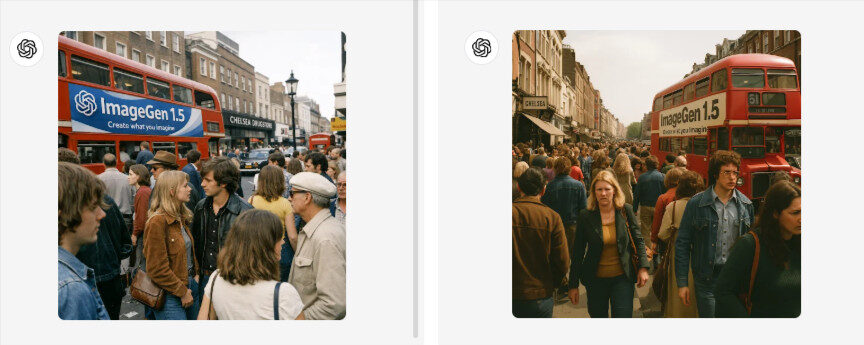
Image Credit: Chatgpt Image
1. Speed and Iteration
GPT Image 1.5 delivers images up to four times faster, allowing users to generate and revise visuals without prolonged wait times. Iterative workflows — critical for advertising, marketing creatives, and rapid prototyping — become practical rather than experimental.
2. Precision Edits and Context Preservation
Earlier image generators often struggled with precise changes. GPT Image 1.5 preserves lighting, shape, composition, and even facial likenesses while making specific alterations — a significant improvement for editorial and version control workflows.
3. Dense Text Rendering
Commercial design workflows increasingly require integrated text — from infographics to posters. GPT Image 1.5’s improved handling of dense text and small typography makes it usable for real-world graphic design tasks previously challenging for many generative models.
4. Creative Space Integration
A new Images workspace within ChatGPT simplifies workflows for users who otherwise might switch between tools or platforms. This hub includes style presets and curated prompts that lower the barrier for less technical users.
Nano Banana Pro vs ChatGPT Image 1.5: A Practical Comparison
To understand where each model fits, it’s helpful to view a head-to-head comparison along key practical dimensions:
Speed and Throughput
- GPT Image 1.5: Up to 4× faster than older OpenAI models; suitable for bulk generation.
- Nano Banana Pro: Often faster in raw generation benchmarks (especially at higher resolution outputs).
Takeaway: GPT Image 1.5 improves iteration speed; Nano Banana Pro still leads in absolute generation time in many scenarios.
Visual Fidelity and Realism
- GPT Image 1.5: Reliable and detailed, particularly strong at prompt adherence.
- Nano Banana Pro: Frequently produces *more photorealistic and polish-ready * visuals, including sharper detail and consistent realism across image families.
Takeaway: Nano Banana Pro typically holds an edge in realism, particularly where visual consistency and natural lighting matter most.
Editing Capabilities
- GPT Image 1.5: Highly flexible editing with semantic awareness; retains key elements during iterative changes.
- Nano Banana Pro: Strong editing and multi-image references — often superior for complex composites.
Takeaway: Both models are competitive, but Nano Banana Pro’s editing shines in layered multi-image contexts.
Text in Images
- GPT Image 1.5: Great improvement, but still sometimes inconsistent with dense or stylized text.
- Nano Banana Pro: More capable with embedded text and labeling accuracy.
Takeaway: If your use case involves text-heavy visuals (e.g., infographics, posters), Nano Banana Pro currently has the edge.
Use Case Fit
| Use Case | Best Fit |
| Rapid iteration/high throughput | GPT Image 1.5 |
| Hyper-realistic imagery | Nano Banana Pro |
| Marketing assets with dense text | Nano Banana Pro |
| Concept art and creative exploration | GPT Image 1.5 |
| UI mockups and rough design | GPT Image 1.5 |
Insight: Neither model universally dominates; choice should be guided by workflow requirements, not headlines.
Real-World Examples and Workflows
Design and Marketing Teams
For marketing campaigns where multiple banners, mockups, and iterations are needed, GPT Image 1.5’s speed and instruction fidelity streamline the rapid ideation process. Marketers can generate variants of a base concept without leaving a collaborative workspace, enabling closer human-AI collaboration.
Product and UI Design
When designers need visual mockups that reflect exact product features or branding, GPT Image 1.5’s precision edits help refine concepts quickly. This can reduce dependencies on dedicated design teams for early draft visuals.
Advertising and Print
In print contexts where dense text and high fidelity are non-negotiable, Nano Banana Pro’s current strength in text rendering and photorealism often produces client-ready visuals with fewer post-generation adjustments.
GPT-5 vs GPT Image 1.5: Complementary, Not Competing
It’s important to clarify that GPT-5 and GPT Image 1.5 serve fundamentally different functions:
- GPT-5 is a text-centric, reasoning-oriented model that can also accept images as inputs for tasks like classification, explanation, and multimodal reasoning. It does not generate standalone visual content.
- GPT Image 1.5 is focused strictly on image generation and editing — not on deep reasoning or decision making.
This distinction resonates with practitioners building multimodal AI systems: you choose the right model for the task. A GPT-5-powered agent could underpin analytical workflows, while GPT Image 1.5 could feed visual content into those workflows.
Limitations and Industry Challenges
Despite its advances, GPT Image 1.5 is not without constraints:
- Resolution ceilings: Compared with high-resolution outputs from some competitors, GPT Image 1.5’s top native resolution is relatively modest.
- Style specificity: Some users report that it still struggles with very niche styles or specialized aesthetic domains relative to models tuned explicitly for those outputs.
- Interface variability: Early adopters note inconsistency between the API and ChatGPT interface experiences, particularly around multi-image workflows.
Understanding these limitations helps set realistic expectations when evaluating tools for production usage.
Future Implications for AI Image Generation
The GPT Image 1.5 launch reflects several broader industry trends:
Diversification of AI Models
Specialized models for text, images, and other modalities — rather than monolithic generalists — are increasingly standard. Domain-specific optimization yields tangible performance and cost advantages.
Professionalization of AI Imagery
AI isn’t just for whimsy or exploratory artwork anymore. Models now address enterprise-grade needs — from product design to brand visuals — with quality, speed, and integration that align with agency workflows.
Democratic Access and Creative Toolchains
By embedding GPT Image 1.5 into ChatGPT and offering API access, OpenAI lowers barriers for creators, developers, and businesses. Organizations can prototype visual ideas without building custom infrastructure, accelerating innovation across sectors.
Competition Drives Innovation
Pressure from competitors like Google’s Nano Banana Pro continues to push developers to refine capabilities and address weaknesses. Users benefit from a richer ecosystem where choice is driven by functionality and fit, not single vendor dominance.
Conclusion: A Strategic Step in the AI Visual Revolution
GPT Image 1.5 isn’t merely an incremental upgrade — it’s part of a broader maturation in AI image generation. By combining speed, precision edits, and accessible integration inside ChatGPT, it gives creators and enterprises a robust tool for visual production. In contexts where speed, iteration, and prompt fidelity matter most, it competes strongly with alternatives like Nano Banana Pro. But for absolute visual realism and print-ready outputs, competitors still hold an edge in some use cases.
For decision-makers, developers, and creators, the key takeaway is that AI imagery is no longer a fringe creative domain. It’s rapidly becoming core to workflows that span design, marketing, user experience, product visualization, and even scientific illustration. ChatGPT Image 1.5 represents a significant milestone on that path — one that will shape how businesses and individuals think about visual content, automation, and the creative interplay between humans and AI.
FAQs
What is ChatGPT Image 1.5?
It’s OpenAI’s latest image generation and editing model, integrated in ChatGPT and available in the API as GPT-Image-1.5, offering faster generation, precise edits, and improved instruction following.
How does GPT Image 1.5 differ from GPT-5?
GPT-5 is a text-reasoning LLM that can interpret images but not generate them; GPT Image 1.5 is dedicated to producing and editing visuals from text prompts or reference images.
Is Nano Banana Pro better than ChatGPT Image 1.5?
That depends on use case — Nano Banana Pro typically excels in realism and text-heavy images, while GPT Image 1.5 shines in speed, instruction adherence, and iterative workflows.
What are key use cases for GPT Image 1.5?
Rapid prototyping, marketing asset creation, UI mockups, creative concept visuals, virtual try-ons, and infographics.
Can GPT Image 1.5 render realistic faces and dense compositions?
Yes — with stronger fidelity and consistency across edits than prior models, though results can vary with prompt complexity and stylistic demands.