
Anthropic has released Claude Opus 5, its newest general-purpose frontier model, priced identically to its predecessor Opus 4.8 but with meaningful gains on coding, knowledge work, and scientific research. According to Anthropic, Opus 5 comes close to the frontier intelligence of the company's Fable 5 at roughly half the cost per task, and sets a new state of the art on benchmarks like Frontier-Bench v0.1 and GDPval-AA. It becomes the default model on Claude Max and the strongest option on Claude Pro. For developers picking between Anthropic's line-up, the release reshuffles the choice between Opus, Sonnet, Fable, and Mythos. This piece walks through what changed, how the benchmarks read, what it costs, and where the safeguards land.
This article covers:
What's actually new in Claude Opus 5
Performance and benchmark results
How Claude Opus 5 stacks up against Fable 5, Mythos 5, and Sonnet 5
Pricing, availability, and Fast mode
Coding, agentic work, and Claude code Opus 5
Safety, alignment, and cybersecurity guardrails
Frequently Asked Questions
What's actually new in Claude Opus 5
Claude Opus 5 is Anthropic's new flagship general-purpose model, replacing Opus 4.8 as the default on Claude Max and the top option on Claude Pro. It ships at the same price as its predecessor but delivers substantially better performance on coding, scientific research, and agentic tasks, alongside stronger safety alignment.
The headline change is efficiency and reliability. Anthropic describes the model as "thoughtful and proactive," designed for daily use rather than heavy-lift-only workloads. It verifies its own work and iterates carefully until a task succeeds, a pattern early-access customers reported repeatedly during pre-launch testing.
The model exposes an "effort" setting that users can tune. Higher effort pushes intelligence and accuracy. Lower effort conserves tokens for faster, cheaper responses. That knob matters for teams running the model at scale, where cost per task can swing significantly depending on how hard the model is allowed to think.
On the sciences side, Opus 5 improves on every one of Anthropic's internal life-sciences evaluations, covering structural biology, organic chemistry, and bioinformatics. Its biggest gains show up in organic chemistry, where it scores 10.2 percentage points higher than Opus 4.8 on inferring molecular structures from spectroscopy data. Protein work sees a 7.7-point gain on predicting how sequence variations affect protein function.
Anthropic also mentions stronger visual outputs, though it does not publish specific numbers on that dimension in the release notes.
Performance and benchmark results
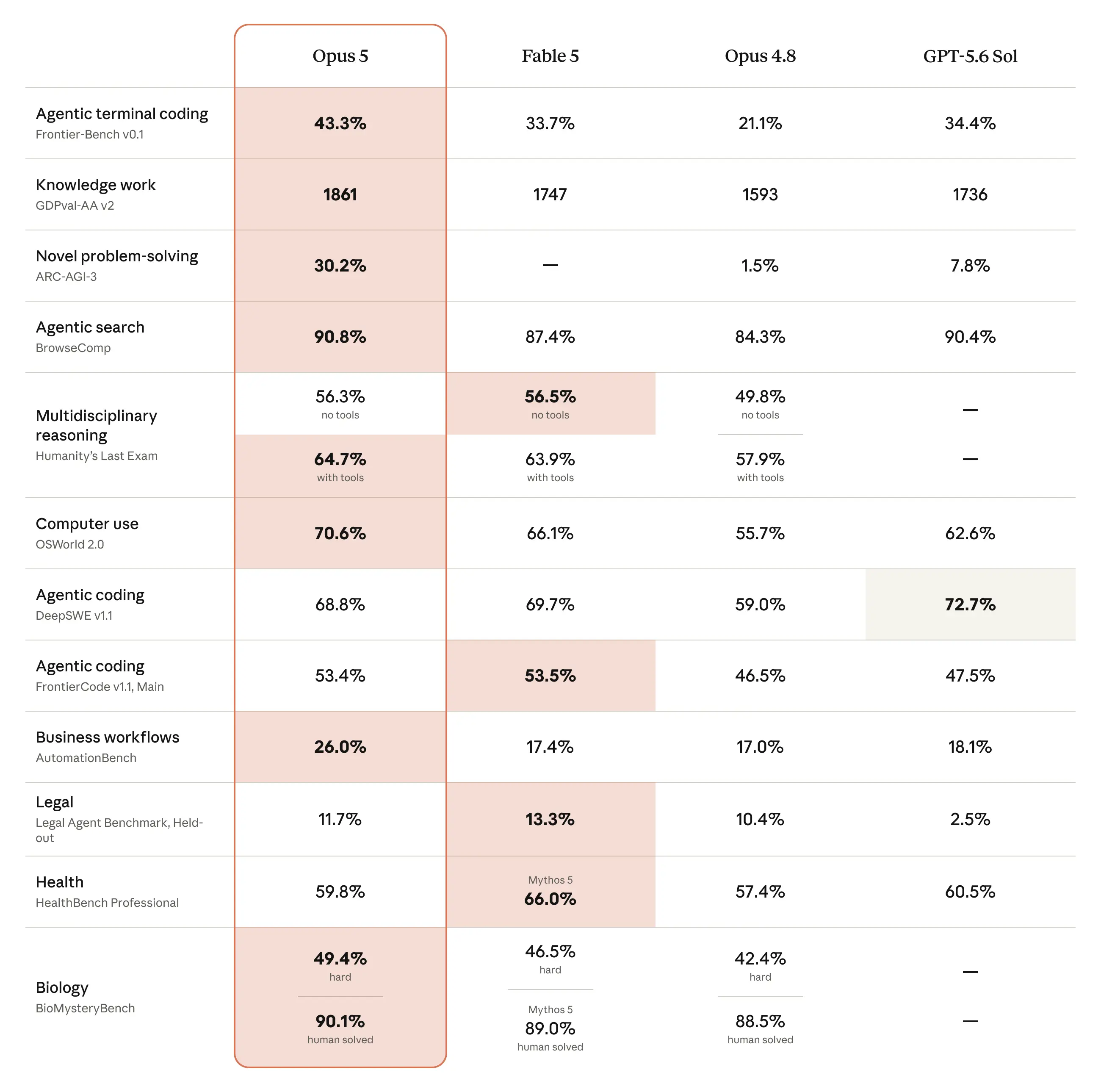
On coding and knowledge work benchmarks, Claude Opus 5 sets a new state of the art among Anthropic's models. It more than doubles Opus 4.8's score on Frontier-Bench v0.1 at a lower cost per task, and on CursorBench 3.2 at max effort it lands within 0.5% of Fable 5's peak score while running at roughly half the cost per task.
The efficiency curve is the one to watch. On high, xhigh, and max effort settings on CursorBench 3.2, Opus 5 delivers better performance-per-dollar than every other model Anthropic tested, including Fable 5. For teams building coding agents where token spend adds up quickly, that curve is the difference between a viable product and a research demo.
How the benchmarks were run
Anthropic notes that the Frontier-Bench v0.1 results were produced on the mini-SWE-agent harness with a GKE backend, averaging reward over five attempts per task. On safety-classifier refusals during those runs, Opus 4.8 served as the fallback for both Opus 5 and Fable 5, which matters because the reported scores reflect the safeguarded product as customers will actually use it, not a raw un-classified model.
Beyond coding, Anthropic reports that Claude Opus 5 is its best and most cost-efficient model on several related knowledge-work and problem-solving evaluations, though the release does not name every single benchmark. It is presented as the new default choice whenever a customer would otherwise reach for Opus 4.8.
How Claude Opus 5 stacks up against Fable 5, Mythos 5, and Sonnet 5
Among Anthropic's current line-up, Claude Opus 5 sits between the faster Sonnet 5 and the peak-intelligence Fable 5, positioned as the everyday frontier model. Mythos 5 remains ahead on offensive cybersecurity exploit development and on long-running autonomous biology research. Opus 5 leads on general coding and knowledge tasks.
Here is how the four models compare across the areas Anthropic highlighted:
Model | Best at | Trade-off |
|---|---|---|
Claude Opus 5 | Coding, knowledge work, science, daily use | Behind Mythos 5 on cyber exploit development |
Claude Fable 5 | Peak frontier intelligence on hardest tasks | Roughly 2x the cost per task versus Opus 5 |
Claude Mythos 5 | Offensive cybersecurity, autonomous biology | Behind Opus 5 on general coding benchmarks |
Claude Sonnet 5 | Speed and lower cost | Behind Opus 5 on complex reasoning and alignment |
On alignment specifically, Anthropic's automated behavioral audit places Opus 5 ahead of Opus 4.8, Sonnet 5, and Fable 5. It exhibits the lowest rates of deceptive behavior in Anthropic's testing and is described as the least susceptible to being tricked into misuse.
The Fable 5 versus Opus 5 comparison is the most consequential for most customers. If a team was reaching for Fable 5 purely for coding or knowledge work, Opus 5 now offers essentially equivalent output at roughly half the cost. Fable 5's edge narrows to the very top of the difficulty distribution, where the extra intelligence justifies the extra spend. For a deeper look at the sibling model, see our Claude Fable 5 breakdown.
Pricing, availability, and Fast mode
Claude Opus 5 costs $5 per million input tokens and $25 per million output tokens, identical to Opus 4.8's pricing. It is available today on all Claude platforms, and Fast mode is offered at twice the base price for approximately 2.5 times the throughput. Developers can start using the model via the claude-opus-5 identifier on the Claude API.
Tier | Input (per 1M tokens) | Output (per 1M tokens) | Relative speed |
|---|---|---|---|
Standard | $5 | $25 | Baseline |
Fast mode | $10 | $50 | ~2.5x faster |
Fast mode is available through the Claude Platform directly and through usage credits in Claude Code. Consistent with prior Opus models, Claude Opus 5 does not have data retention requirements for general access, which matters for teams working with sensitive customer data or subject to compliance constraints.
Two beta updates ship alongside the model release, though Anthropic has not detailed the full scope of those betas in the launch announcement. Teams already on Anthropic's stack can start testing Opus 5 without changing their pricing plan.
Coding, agentic work, and Claude code Opus 5
Claude code Opus 5 is where the efficiency gains hit hardest, since coding tasks tend to spend heavily on both input context and output tokens. Opus 5 more than doubles Opus 4.8's Frontier-Bench score at lower cost per task, and it matches Fable 5 within 0.5% on CursorBench 3.2 at max effort while spending roughly half as much per task.
The agency story matters as much as the raw numbers. Anthropic and its early-access customers report that Opus 5 verifies its own work and iterates carefully until it succeeds. In practice, that means fewer surprise failures on multi-step tasks and fewer retries eating budget. For coding agents that run unattended, thoroughness is often worth more than raw peak intelligence.
If you are choosing between running the model in Claude Code versus using it through the API, the practical decision comes down to how you want Fast mode billed. Claude Code uses usage credits. The API bills at the doubled Fast-mode rate directly. For a team weighing whether to build with Anthropic's stack or a competing vendor's, our breaks down the trade-offs.
Safety, alignment, and cybersecurity guardrails
Anthropic reports that Claude Opus 5 is its most aligned model to date, with the lowest rates of deceptive behavior and the strongest adherence to Claude's Constitution across its internal behavioral audits. Its cybersecurity guardrails are proportionally looser than those on Fable 5, expected to intervene about 85% less often, though they still block binary-based scanning, penetration testing, and exploit generation.
On raw capability, Opus 5 does not push the frontier in dual-use risk areas. In rigorous evaluations conducted with private-sector and government partners, Anthropic found it remains behind Mythos 5 in both biology research and offensive cybersecurity. Anthropic deliberately avoided training Opus 5 on cyber-specific tasks, though the model has still improved substantially on those tasks as a byproduct of becoming more generally capable.
Cybersecurity: what's allowed, what's blocked
Anthropic's evaluation of the model on OSS-Fuzz, an internal adaptation of the open-source fuzzing project maintained by Google, tells the clearest story. Opus 5 identifies vulnerabilities in source code at rates similar to Mythos 5. On the follow-up step of turning those vulnerabilities into working exploits, Opus 5's score falls far behind Mythos 5's. That gap is by design.
Flagged cybersecurity requests fall back to Opus 4.8 by default in Claude.ai, Claude Code, and Claude Cowork. Teams that need fewer restrictions can enable the fallback behavior on the API or apply to Anthropic's Cyber Verification Program, which grants enterprises and researchers access to a version of the model with looser security classifiers.
Biology safeguards
Biology guardrails on Opus 5 are similar to those Anthropic applied to Opus 4.8, which now makes it the company's most capable generally available model for scientific research. Anthropic notes important limitations remain on long-running, autonomous research tasks, which is where the largest biology risks concentrate. Biology-related requests that would have been blocked on Fable 5 now route to Opus 5 rather than Opus 4.8, a meaningful upgrade in day-to-day capability for life-sciences teams.
For a comparison against another current frontier release in the same weight class, see our rundown of Google's latest.
What to do next
If you are already on Claude, the practical step is to switch your default to Opus 5 and re-run one or two of your most cost-sensitive workloads with the effort setting turned down. Most teams will find that the same or better output lands at lower spend than under Opus 4.8. If you rely on cybersecurity workflows, budget time to test whether your prompts still pass the new classifiers, and file for the Cyber Verification Program if they do not. For teams still comparing Anthropic against other vendors before committing, our round-up covers the current field.
FAQs
How much does Claude Opus 5 cost?
Claude Opus 5 is priced at $5 per million input tokens and $25 per million output tokens on the standard tier, the same as Opus 4.8. Fast mode doubles those rates and delivers roughly 2.5 times the throughput. Pricing is identical across the Claude API, Claude Max, and Claude Pro entry points.
Is Claude Opus 5 better than Claude Fable 5?
On coding and knowledge work, Opus 5 lands within 0.5% of Fable 5's peak score on CursorBench 3.2 at max effort, at roughly half the cost per task. Fable 5 retains the edge on the very hardest frontier tasks and on some safety-restricted domains. For most everyday work, Opus 5 is the more cost-effective choice.
Can I use Claude Opus 5 for cybersecurity work?
Yes, for source-code vulnerability discovery. The model's classifiers block binary-based vulnerability scanning, penetration testing, and exploit generation. Flagged requests fall back to Opus 4.8. Enterprises and researchers accepted into Anthropic's Cyber Verification Program have access to a version with fewer security restrictions.
What is Fast mode on Claude Opus 5?
Fast mode runs Claude Opus 5 at roughly 2.5 times the default speed, priced at twice the base per-token rate. It is available on the Claude Platform and through usage credits in Claude Code. Standard-mode and Fast-mode outputs are drawn from the same underlying model.
Does Claude Opus 5 replace Opus 4.8?
It is the new default on Claude Max and the strongest option on Claude Pro, so most users will move to it automatically. Opus 4.8 remains available and serves as the automatic fallback for cybersecurity requests that Opus 5's classifiers block. Teams can continue calling Opus 4.8 explicitly on the API.