
GPT-5.2-Codex is the latest agentic coding model from OpenAI, specifically designed to support complex, real-world software engineering and cybersecurity tasks. Built on the GPT-5.2 architecture and further optimized for coding workflows, GPT-5.2-Codex represents a major advance in large language models tailored for professional developer use. Its release highlights how AI is evolving from simple code suggestion tools into full-scale development partners capable of handling long-duration, multi-step engineering tasks.
This article provides an in-depth analysis of GPT-5.2-Codex, explores how it differs from competing tools like Claude Code, and gives developers and decision-makers practical insights into real-world applications, strengths, limitations, and adoption considerations.
What Is GPT-5.2-Codex?
GPT-5.2-Codex is OpenAI’s most advanced agentic coding model to date. It extends the general-purpose intelligence of GPT-5.2 with enhanced capabilities tailored to software engineering and defensive cybersecurity. Unlike generic GPT models that generate text based on patterns, GPT-5.2-Codex is designed to understand codebases, plan multi-step implementations, apply context to long-running tasks, and execute complex workflows with real tools.
At launch:
- It supports context compaction, helping the model maintain relevance across long sequences and large repositories.
- It delivers improved performance on key engineering benchmarks such as SWE-Bench Pro and Terminal-Bench 2.0, demonstrating strong real-world coding proficiency.
- It shows enhanced cybersecurity capabilities, making it useful for vulnerability analysis and defensive research.
Initially available to paid ChatGPT users, broader API access is rolling out with safety controls and trusted access for research teams.
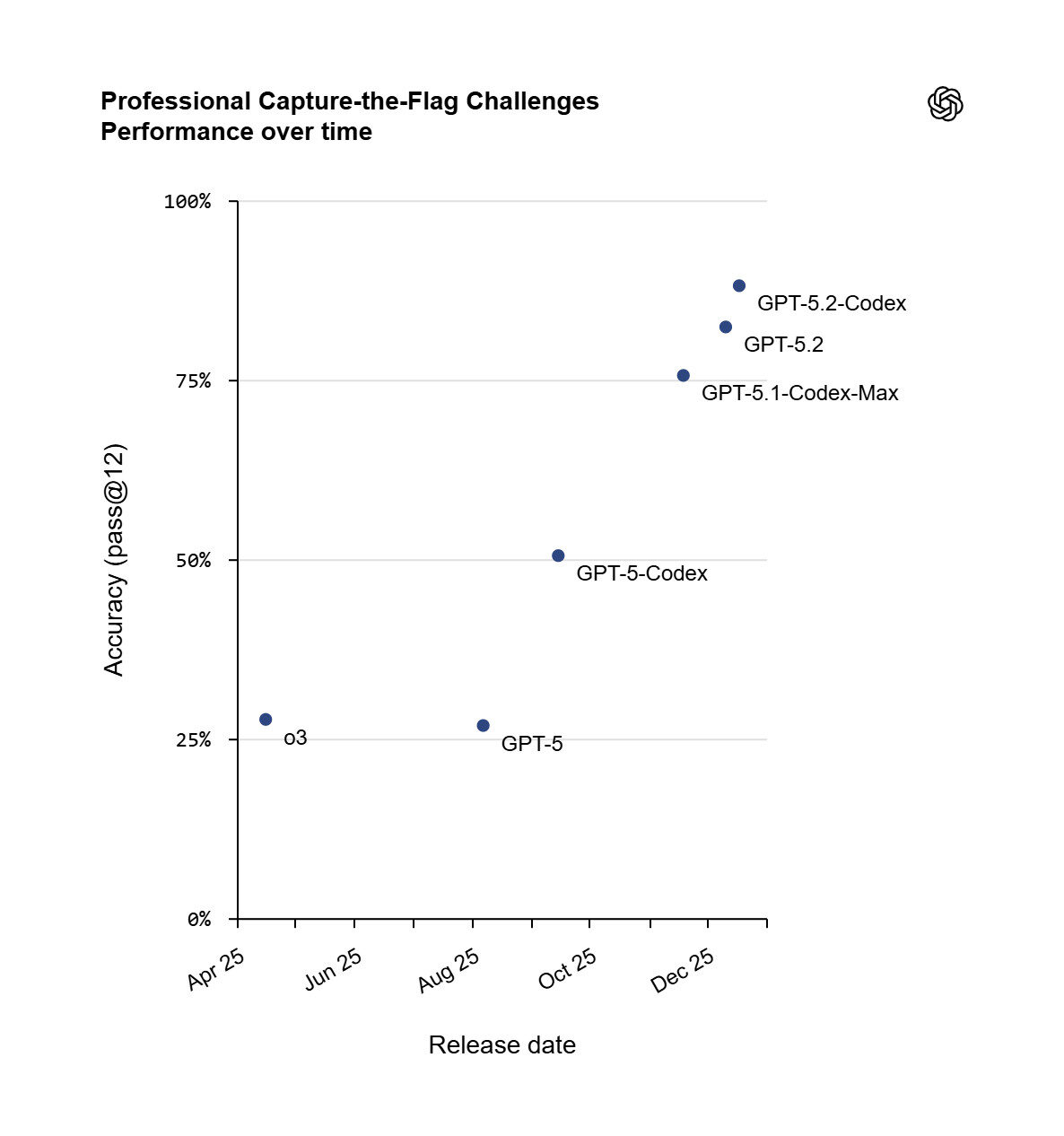
GPT-5.2-Codex vs. GPT-5.2 vs. GPT-5.1-Codex-Max: A CTF Performance Timeline
Core Features of GPT-5.2-Codex
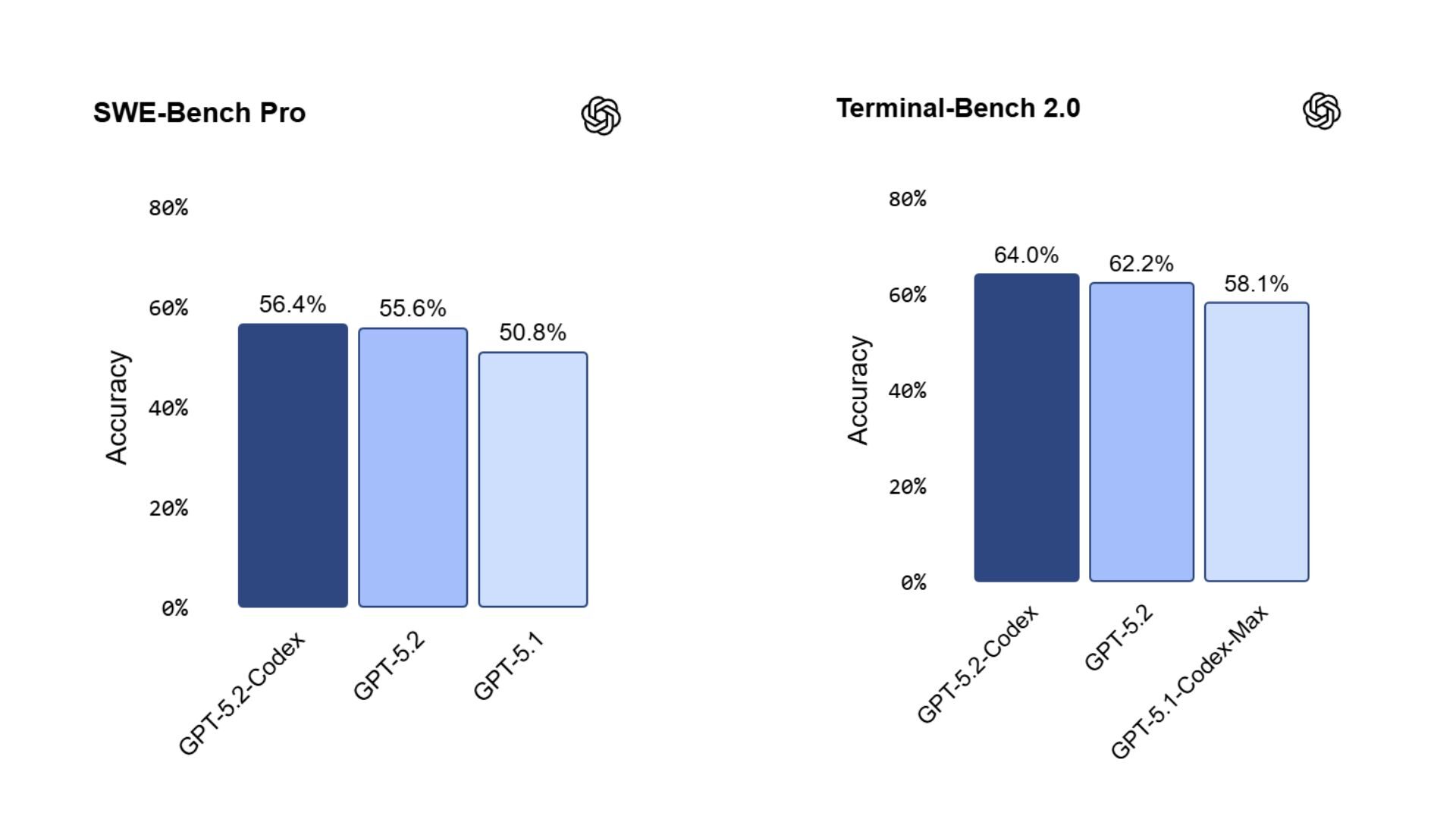
Image Credit: Openai
1. Long-Horizon Coding and Project-Scale Work
GPT-5.2-Codex is designed to work across entire codebases, not just generate snippets. It maintains context over extended sessions, enabling it to:
- Perform large refactors
- Execute migrations
- Build features that span multiple modules
- Iterate on complex plans without losing context mid-task
Traditional AI coding assistants often struggle when tasks span many files or slip beyond simple prompts. GPT-5.2-Codex bridges that gap with robust context tracking and workflow continuity.
2. Comprehensive Coding Benchmarks
State-of-the-art performance on software engineering benchmarks supports GPT-5.2-Codex’s real-world capabilities:
- It achieves high scores on SWE-Bench Pro, which measures realistic engineering tasks.
- It performs strongly on Terminal-Bench 2.0, indicating proficiency in real terminal environments.
These results reflect not just code generation but agent-level performance—taking actions like a developer would.
3. Integrated Tool Execution and Context Awareness
GPT-5.2-Codex goes beyond static code generation:
- It can interpret screenshots and UI mocks into code.
- It supports improved tool usage and integrates into native environments like Windows more reliably.
- It handles long-term development cycles with context persistence and compaction that retain relevant code history.
This makes it suitable for developer workflows where maintaining a full project overview is essential.
4. Enhanced Cybersecurity Capabilities
GPT-5.2-Codex includes stronger cybersecurity reasoning compared to prior versions. It can assist in identifying vulnerabilities, performing capture-the-flag style exercises, and supporting ethical security research.
This dual use—supporting both software construction and defensive work—positions it uniquely among coding assistants.
Who Should Use GPT-5.2-Codex?
GPT-5.2-Codex is particularly valuable for:
- Professional software engineers building complex applications
- Development teams needing consistent multi-module outputs
- Cybersecurity analysts exploring code weaknesses
- Toolchain engineers automating aspects of CI/CD pipelines
Its design enables agent-level autonomy without requiring developers to micromanage every step, while still preserving human oversight.
GPT-5.2-Codex vs. Claude Code: Side-by-Side Comparison
When choosing a coding AI, two of the leading options in late-2025 are OpenAI’s GPT-5.2-Codex and Anthropic’s Claude Code. Both are agentic coding assistants, but they differ in strengths, workflows, and ideal use cases.
| Aspect | GPT-5.2-Codex | Claude Code |
| Core Focus | End-to-end engineering, project-scale workflows | Developer-in-loop local workflows |
| Context Handling | Strong long-horizon persistence | High local context awareness |
| Benchmark Performance | State-of-the-art agentic coding | Strong across varied tasks but slightly behind in some benchmarks |
| Coding Style | Detailed, enterprise-grade code | Readable, concise, prototyping-friendly |
| Workflow Integration | Cloud sandboxes + local tools | Primarily terminal/IDE |
| Best Use Cases | Large refactors, migrations, complex build pipelines | Stepwise refactors, architectural understanding, exploratory development |
Interpretation of Comparison
- GPT-5.2-Codex excels at larger engineering workflows where continuity, planning, and multi-step execution matter. Its context compaction and integrated benchmarks make it a go-to for backend system design and enterprise engineering.
- Claude Code is strong when developers want a local, interactive coding workflow that lives in the terminal and IDE, providing detailed architectural insights and stepwise guidance.
In practice, many teams use both tools: Codex for broad, autonomous tasks, and Claude Code when deep, interactive exploration or local refinement is required.
Real-World Use Cases
1. Large-Scale Refactoring Projects
GPT-5.2-Codex can:
- Understand entire codebases
- Propose patches
- Execute changes iteratively
- Run tests and update workflows
This makes it suitable for modernization efforts like migrating frameworks or reorganizing architecture.
2. Cybersecurity Audits and Vulnerability Analysis
The model’s improved cybersecurity capabilities help teams perform vulnerability scans, analyze exploit behavior, and assist defensive research workflows with higher accuracy than general-purpose models.
3. IDE Integration and Developer Acceleration
Through Codex CLI and IDE extensions, developers can:
- Generate code directly in editors like Visual Studio Code
- Automate routine tasks like test scaffolding
- Use terminal commands for real-time assistance
This tight integration reduces context switching and enhances productivity.
Conclusion
GPT-5.2-Codex represents a pivotal step in AI-driven software engineering, combining the latest advancements from OpenAI with a focus on agentic, project-level coding workflows. Its strengths in context persistence, benchmark performance, and cybersecurity make it a powerful tool for enterprise and professional developers.
Comparatively, Claude Code remains a valuable option for interactive, local development experiences and architectural exploration. Choosing between them should be informed by your workflow needs — whether your priority is autonomous, long-horizon engineering or tight terminal/IDE interaction.
Together, these tools reflect the evolution of AI coding assistants in 2025, where AI becomes an active collaborator in development rather than a passive code suggestion engine. As adoption grows, both models will continue shaping how developers build, secure, and scale software.
Common Questions About GPT-5.2-Codex
What is GPT-5.2-Codex designed for?
It’s a specialized agentic coding model optimized for complex software engineering tasks, large refactors, and cybersecurity workflows, extending GPT-5.2’s capabilities for real-world coding.
How does GPT-5.2-Codex compare to Claude Code?
GPT-5.2-Codex excels in handling large codebases and multi-step development tasks with high benchmark performance, while Claude Code often performs well in local, interactive terminal workflows and readable code generation.
Where is GPT-5.2-Codex available?
Released to paid ChatGPT users in Codex surfaces, with broader API access planned under controlled rollout.
Can GPT-5.2-Codex replace developers?
It’s meant to augment engineering workflows, not replace human developers; human oversight remains critical for architectural decisions, reviews, and production readiness.
What benchmarks show its performance?
It demonstrates strong results on SWE-Bench Pro and Terminal-Bench 2.0, indicating proficiency in realistic coding tasks.