
Key Takeaways
Muse Glimmer 30B is Meta's newest open-weight model, a 30-billion-parameter agentic AI released on August 10, 2026, built specifically for local, always-on agents rather than a general-purpose chatbot.
It's fully open source under Apache 2.0 — free for commercial and research use, with no per-token API fees and no usage restrictions.
The model is distilled from Muse Spark, Meta's larger closed model, which stays private and accessible only through Meta's paid Model API.
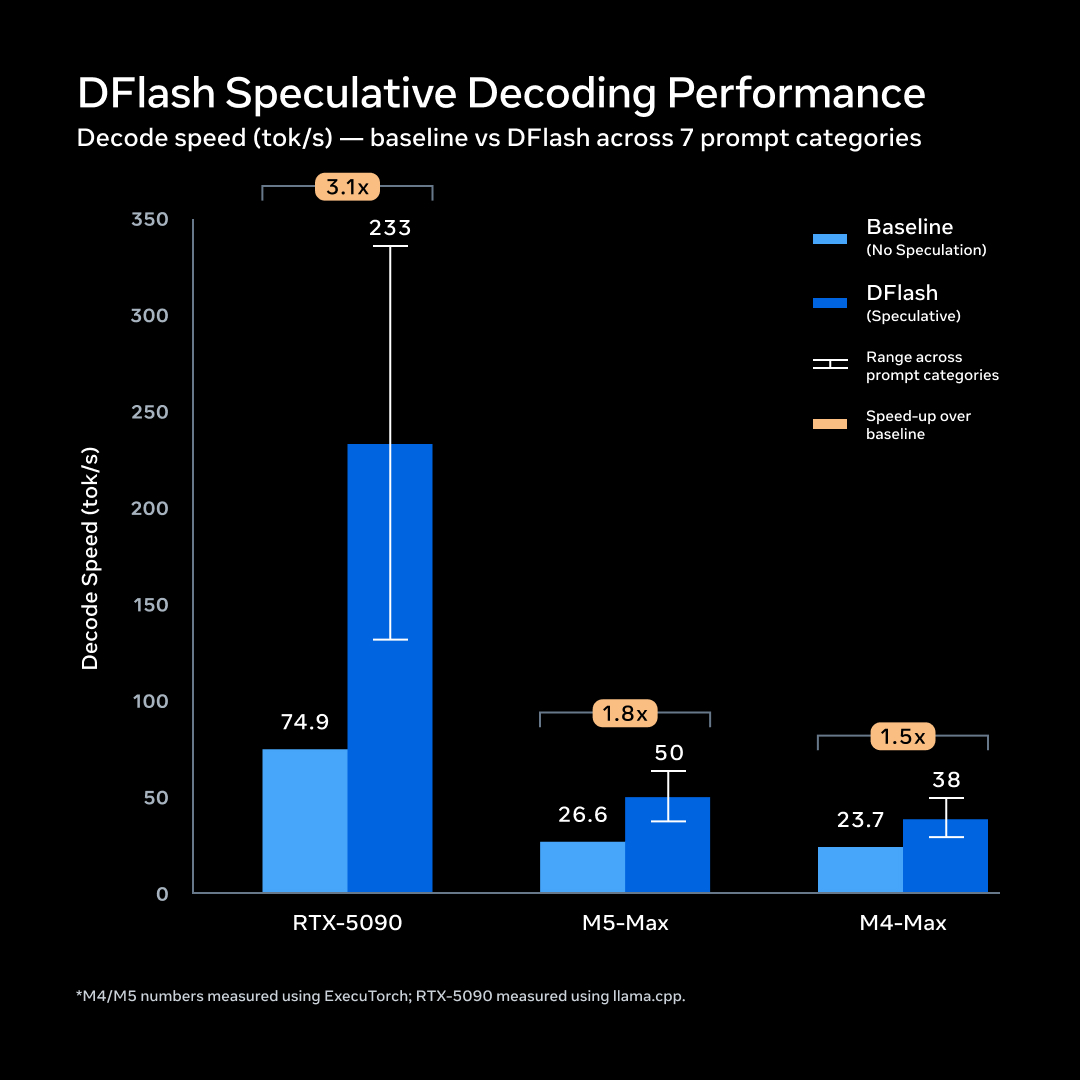
It runs on a single 24GB or 32GB consumer GPU or Mac, thanks to 4-bit quantization and DFlash speculative decoding, which delivers up to 3.1x faster generation on an RTX 5090.
On Meta's own benchmarks, Glimmer leads Gemma 4 31B by a clear margin and holds its own against Qwen 3.6 27B on agentic and reasoning tasks — but Qwen still leads on terminal-based coding benchmarks like TerminalBench and OSWorld.
Meta has signaled that open weights for Muse Spark 1.2 may follow, which would make the broader Muse model family a much bigger deal for the open-weight AI market.
This is a working, day-one-usable model — with support already landing across Hugging Face, Ollama, llama.cpp, MLX, and ExecuTorch — not just a benchmark announcement.
Muse Glimmer 30B is a dense, multimodal, open-weight AI model from Meta, released under the Apache 2.0 license on August 10, 2026. It is optimized for local agentic workflows — including tool use, coding, and multi-step reasoning — and can run on a single 24GB or 32GB consumer GPU thanks to 4-bit quantization and speculative decoding.
This guide breaks down everything you need to know about Meta Muse Glimmer: what it is, how it was built, how it performs against rivals like Qwen 3.6 27B and Gemma 4 31B, and exactly how to get it running on your own machine.
What Is Muse Glimmer 30B?
Muse Glimmer is the newest model from Meta Superintelligence Labs, the division formed after Meta's acquisition of key talent from Scale AI. Instead of positioning it as another general-purpose chatbot, Meta built Glimmer around a specific use case: local, persistent AI agents that can plan tasks, call external tools, read screenshots and documents, and keep working across long, multi-step workflows — all without sending data to the cloud.
The model was distilled from Muse Spark, a larger, closed model that serves as its "teacher." Through this distillation process, Meta compressed much of Muse Spark's reasoning and agentic capability into a package small enough to fit on everyday hardware, while keeping the original model private and accessible only through Meta's Model API.
The name itself hints at this relationship — Glimmer is a smaller reflection of the more capable Spark.
Muse Glimmer 30B Release Date and Background
Meta officially introduced Muse Glimmer on August 10, 2026, alongside open-weight downloads on Hugging Face and developer documentation to help engineers start building immediately. The launch arrived as part of a broader push by Meta to re-establish itself in the open-weight AI race, alongside CEO Mark Zuckerberg's public arguments for fewer regulatory barriers on open-source AI in the United States.
Meta has also signaled that this is only the beginning of a larger rollout: the company has said it plans to eventually open-source weights for Muse Spark 1.2, the more advanced closed model that Glimmer was distilled from, which would make the broader Muse model family significantly more important for the open AI ecosystem.
The release positions Meta against a fast-moving field of open-weight competitors, most notably Alibaba's Qwen 3.6 27B and Google DeepMind's Gemma 4 31B, both of which occupy a similar size class and target similar local-deployment use cases.
Muse Glimmer 30B Features
Meta designed Muse Glimmer around eight core capabilities that, together, are meant to make it function as a genuine autonomous agent rather than a simple question-and-answer chatbot:
End-to-end agentic task completion — The model is trained and measured on full-task benchmarks such as DeepSearch QA, MCP-Atlas, τ-Bench, and SWE-Bench, which test its ability to operate inside real agent scaffolds and finish multi-turn jobs from start to finish, not just answer isolated questions.
Reliable tool use — Glimmer can invoke a wide range of function calls with precise schemas, even across long, extended workflows involving multiple tool calls in sequence.
Multi-step reasoning — The model is built to sustain coherent plans over long reasoning chains, rather than losing track of the objective partway through a task.
Failure recovery — When a tool call fails or produces an unexpected result, Glimmer is trained to diagnose the problem and retry, instead of simply halting the task.
Multimodal input and reasoning — A dedicated perception encoder lets the model accept interleaved text and images, so an agent built on Glimmer can interpret screenshots, charts, and documents alongside a normal conversation.
Scaffold compatibility — The model is built to work within existing agent orchestration frameworks, including OpenClaw.
Controllable effort — Developers can adjust the model's reasoning strength, trading off speed against depth of reasoning depending on the task.
Multilingual support — Muse Glimmer was trained on data spanning more than 100 languages.
Technical Specifications
Independent analysis of the released model files points to the following architecture details:
Parameters: Roughly 29.6–30 billion, including a dedicated vision tower
Architecture: Dense causal transformer (not a mixture-of-experts design), so all parameters activate on every forward pass
Vision encoder: A roughly 1.8-billion-parameter perception encoder capable of processing up to 4,096 visual tokens per image
Context window: 131,072+ tokens
Vocabulary: Approximately 202,048 tokens
Attention design: Grouped-query attention combined with sliding-window attention in a repeating local/local/local/global pattern
Knowledge cutoff: Early January 2026
Input/output: Accepts text and images; generates text only (video is handled as a sequence of individual frames, and audio is not supported)
This architecture is closer in spirit to Google's Gemma family than to a mixture-of-experts model like some larger Qwen variants, though Glimmer uses several of its own tweaks, including SwiGLU activations and a more aggressive local-to-global attention ratio.
Is Muse Glimmer 30B Open Source?
Yes. Muse Glimmer is released under the Apache 2.0 license, one of the most permissive open-source licenses available, which allows both commercial and research use without the usage restrictions attached to some earlier Meta model releases.
The Hugging Face model repository includes:
Full BF16 precision weights
GGUF k-quant versions for llama.cpp-based tools
ExecuTorch builds for on-device and mobile deployment
The lightweight DFlash "drafter" model used for speculative decoding
Because the license is genuinely permissive rather than restricted to research or capped by usage limits, developers and companies can self-host Muse Glimmer, fine-tune it, and deploy it commercially without paying Meta a licensing fee — a meaningful point of differentiation from closed, API-only models.
Muse Glimmer 30B Benchmarks
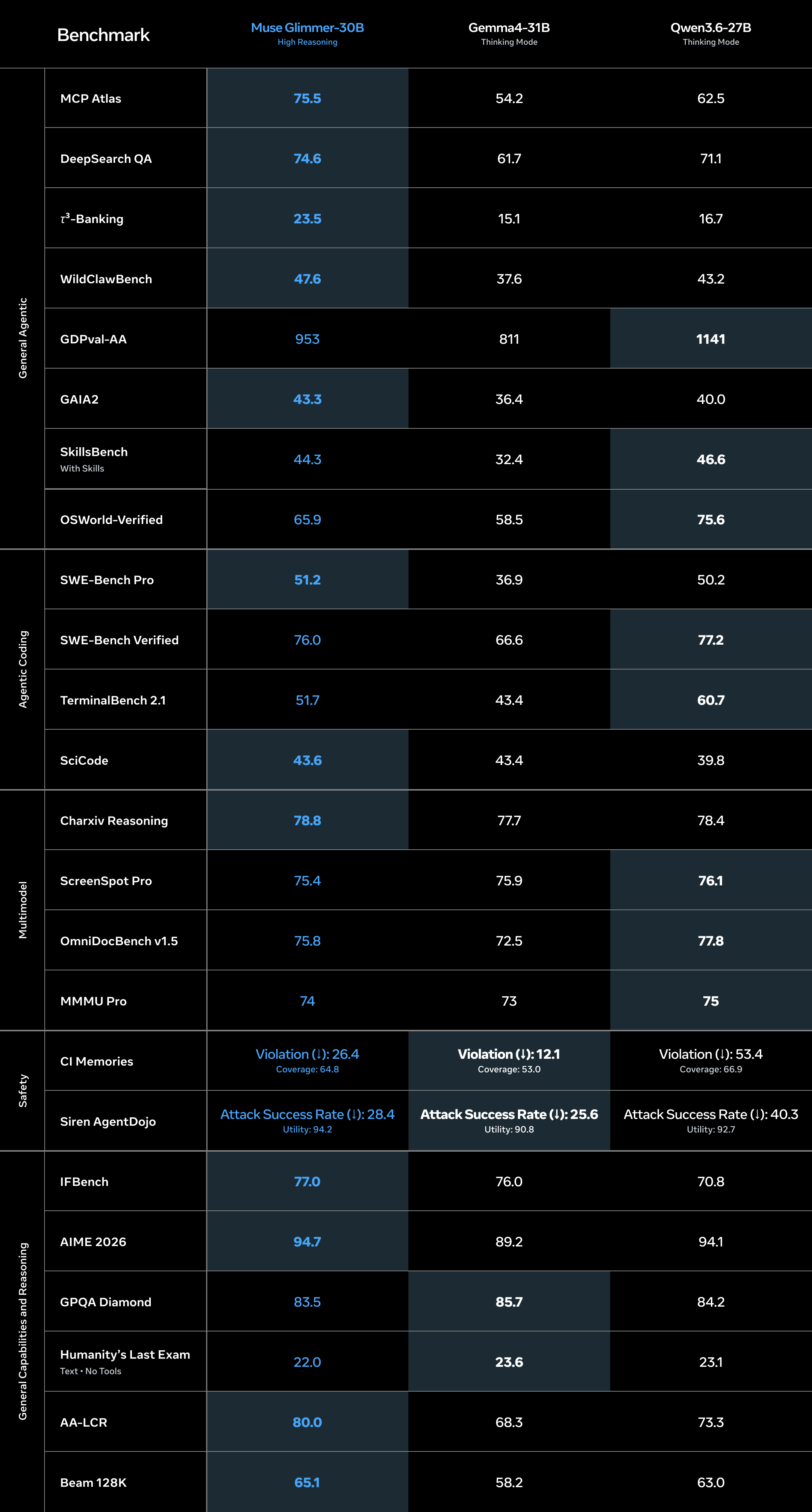
Image: Meta
Meta's own published evaluation compares Muse Glimmer against Gemma 4 31B and Qwen 3.6 27B — the two most direct competitors by size, license, and target use case — across agentic, coding, multimodal, safety, and reasoning benchmark categories. According to Meta's evaluation methodology report, Glimmer performs strongly for its size class on several widely used benchmarks, though the results are not a uniform sweep in any single model's favor.
Independent reviewers who examined the full benchmark table generally describe the picture as mixed rather than dominant in either direction:
Where Glimmer tends to lead: Agentic task completion (MCP-Atlas, DeepSearch QA), long-context handling, general instruction following, and several reasoning benchmarks such as AIME.
Where Qwen 3.6 27B tends to lead: Terminal and shell-based coding tasks (TerminalBench, OSWorld), SWE-Bench Verified, and a number of multimodal evaluations.
Where Gemma 4 31B tends to lead: A handful of knowledge and safety-related benchmarks.
It's worth noting a caveat that several independent analysts have pointed out: Meta selected either a competitor model's self-reported score or its own reproduction of that model's performance, whichever was more favorable to the comparison, and used third-party aggregators like Artificial Analysis where all three models were covered. This is a reasonably transparent methodology, but it means the comparison should be read as a useful directional signal rather than a fully neutral, third-party benchmark sweep.
Separately, on the independent Artificial Analysis Intelligence Index — a composite score aggregating multiple benchmarks — Muse Glimmer has been reported as sitting slightly behind Qwen 3.6 in overall ranking, even though it leads on Meta's own selected benchmark categories. This kind of gap between vendor-published tables and independent composite indices is common at launch and tends to narrow as more real-world testing accumulates.
Muse Glimmer 30B vs Qwen 3.6 27B
These two models are the closest head-to-head comparison in the current market: both are dense, Apache 2.0-licensed models sized to run in roughly 18–24GB of VRAM.
Agentic reasoning and planning: Muse Glimmer generally has the edge, particularly on tasks requiring search, structured tool calls, and long multi-step plans.
Coding and terminal automation: Qwen 3.6 27B is generally considered the safer choice for day-to-day, repository-level coding and shell command execution, leading on TerminalBench and OSWorld.
Licensing and hardware: Both are free, Apache 2.0-licensed, and fit comparably sized consumer hardware budgets.
Muse Glimmer 30B vs Gemma 4 31B
Meta's published results show Glimmer ahead of Gemma 4 31B on agentic benchmarks such as MCP-Atlas, DeepSearch QA, and SWE-Bench Pro, by a wider margin than its lead over Qwen. Architecturally, Glimmer and Gemma 4 share several design choices — including similar normalization placement and attention patterns — making them structurally closer relatives than Glimmer and Qwen, even though their benchmark profiles differ.
How to Run Muse Glimmer 30B Locally
One of Muse Glimmer's core selling points is that it's genuinely practical to run on hardware you already own. Here's what that looks like in practice.
Hardware Requirements
At full BF16 precision, a 30-billion-parameter model would require more than 55GB of memory — well beyond what any consumer GPU offers. To solve this, Meta compressed Muse Glimmer to roughly 4-bit precision, shrinking the language model itself to under 20GB. That leaves enough headroom for the model's KV cache, the vision encoder, and the DFlash speculative decoding drafter to run together within a 24GB or 32GB memory envelope — which covers most modern consumer GPUs (such as an RTX 4090 or RTX 5090) as well as Apple Silicon Macs with sufficient unified memory (M4 Max, M5 Max, and similar chips).
Meta reports that this level of compression introduces minimal to no measurable degradation on agentic task performance, based on its own internal validation.
Speculative Decoding for Faster Responses
Standard language models generate text one token at a time, which can feel sluggish during long reasoning chains or multi-step tool calls — a real problem for an "always-on" agent that needs to feel responsive. Muse Glimmer addresses this with DFlash, a small companion "drafter" model that proposes entire blocks of tokens at once, which the main model then verifies in parallel rather than checking every token individually.
According to Meta's own benchmarking, this speculative decoding approach delivers meaningful real-world speedups:
~3.1x faster decoding on an RTX 5090
~1.8x faster decoding on an Apple M5 Max
~1.5x faster decoding on an Apple M4 Max
Step-by-Step: Getting Started
Download the weights. Head to the official Hugging Face repository and choose the format that matches your setup — BF16 for full precision, GGUF for llama.cpp-based tools, or ExecuTorch for on-device deployment.
Pick a runtime. Muse Glimmer is supported (or gaining support) across a wide range of local inference tools, including Ollama, LM Studio, Unsloth, llama.cpp, MLX (for Apple Silicon), and ExecuTorch (for edge and mobile devices).
Choose your quantization level. For a 24GB card, Meta recommends its more compressed ~17GB k-quant build. For 32GB systems, a less compressed dynamic quant is available for slightly higher fidelity.
Run your first prompt. Using Ollama, for example, a basic call looks like this:
ollama run muse-glimmer:30b
- Connect it to an agent scaffold. For genuine agentic workflows — file access, tool calls, browsing — pair Glimmer with a compatible orchestration framework such as OpenClaw, following Meta's developer documentation.
For teams that want to skip local setup entirely, Meta also notes that Muse Glimmer is becoming available through hosted inference partners such as Together AI, Fireworks AI, and OpenRouter, as well as scale-oriented serving frameworks like vLLM and SGLang.
Real-World Use Cases
Because Muse Glimmer runs without a network connection and without per-token API costs, it opens up use cases that are awkward or expensive with cloud-only models:
Privacy-sensitive local agents that read and act on personal files, screenshots, or documents without that data ever leaving the device
Local coding assistants for developers who want AI pair-programming without sending proprietary source code to a third-party API
Offline or intermittent-connectivity environments, such as field work or secure facilities where cloud access isn't available or permitted
LLM-as-a-judge evaluation pipelines, where Glimmer can score or review outputs from other systems locally
Cost-sensitive, high-volume automation, where avoiding per-request API pricing meaningfully changes the economics of running an AI agent at scale
Final Thoughts
Muse Glimmer 30B represents a meaningful shift in how Meta is approaching open-weight AI — moving away from general-purpose chatbots and toward compact, genuinely local agents that can plan, use tools, see, and recover from errors without relying on the cloud. Its benchmark story against Qwen 3.6 27B and Gemma 4 31B is mixed rather than dominant, and that's arguably the more honest and useful takeaway: no single model in this size class wins everywhere, and the right choice depends heavily on whether your priority is agentic reasoning, raw coding throughput, or multimodal understanding.
For developers evaluating local AI options in 2026, Muse Glimmer 30B is a serious, well-documented, and genuinely free option worth testing directly against your own workloads rather than relying on any single vendor's benchmark table.
FAQs
What is Muse Glimmer 30B?
Muse Glimmer 30B is an open-weight, 30-billion-parameter AI model from Meta Superintelligence Labs, released on August 10, 2026, and designed to run locally on consumer hardware for agentic tasks like tool use, coding, and multi-step reasoning.
When was Muse Glimmer 30B released?
Meta released Muse Glimmer on August 10, 2026, alongside open weights on Hugging Face and full developer documentation.
Is Muse Glimmer 30B free and open source?
Yes. It is released under the Apache 2.0 license, which permits free commercial and research use, including self-hosting and fine-tuning, without licensing fees.
How much VRAM do I need to run Muse Glimmer 30B?
Meta's quantized builds are designed to run within a 24GB or 32GB memory envelope, covering most modern consumer GPUs and high-memory Apple Silicon Macs.
Is Muse Glimmer 30B better than Qwen 3.6 27B?
It depends on the task. Glimmer tends to lead on agentic planning, tool use, and long-context reasoning, while Qwen 3.6 27B tends to lead on terminal-based coding and shell automation tasks. Neither model dominates across every benchmark category.
Can Muse Glimmer 30B understand images?
Yes. A dedicated perception encoder allows it to accept interleaved text and images, so it can interpret screenshots, charts, and documents as part of a conversation. It does not support audio, and video is processed as a series of individual frames.
Where can I download Muse Glimmer 30B?
The official weights are available on Hugging Face, with supporting developer documentation on Meta's AI Developer Center.
Not Sure Which AI Coding Tools Are Right for Your Business?
The AI landscape is moving fast — Meta Muse Glimmer 30B, Muse Spark 1.2, Claude Opus 5, Codex — and every week brings a new model claiming the top spot. Knowing which tools to adopt, when, and how requires more than reading benchmarks. TechNow helps organisations cut through the noise and turn the right AI capabilities into real business value.
What You'll Get
- AI Strategy Consulting: We analyse your current tech stack, identify where tools like local AI agents or custom coding assistants could move the needle, and build a clear AI roadmap tailored to your goals — not the vendor's.
- Custom AI Development: Whether you need a bespoke coding agent, an internal AI assistant, or a model fine-tuned on your own codebase, our engineers handle everything from requirements to deployment — cloud, hybrid, or on-premise.
- Ready-Made AI Solutions: Get started fast with proven products like CompanyGPT or our AI competitive analysis tool, backed by 60+ completed projects and a 100% client satisfaction rate.
- AI Training & Upskilling: Help your developers evaluate and use emerging tools like Muse Glimmer 30B confidently — with hands-on workshops covering prompt engineering, Microsoft Copilot, and the latest AI tooling.
- Implementation & Project Management: We don't just advise — we build, deploy, and manage, acting as a long-term strategic partner rather than a one-off vendor.
The teams that act now — with the right guidance — will be the ones who turn today's fast-moving AI releases into tomorrow's competitive advantages.